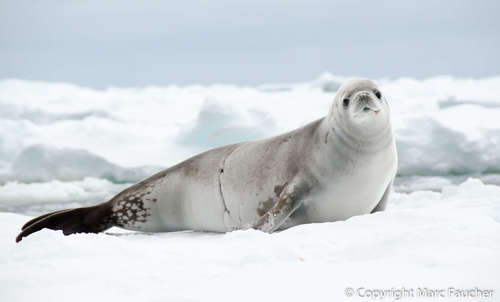
Crabeater Seal
Lobodon carcinophaga
The world's most abundant seal is a master of the Antarctic ice. With specialized teeth for krill-filtering and incredible speed on the frozen pack, the Crabeater Seal is a true polar icon.
Quick Identification
Size
Length: 2.1–2.6 m (7–8.5 ft); Weight: 200–400 kg (440–880 lb)
Colors
Silvery-grey to creamy white, fading to pale blonde after molting; younger seals often have darker chocolate-brown flippers and markings on their backs.
Key Features
- Intricately lobed, sieve-like teeth for filtering krill
- Slender, dog-like snout
- Pale, uniform coat color
- Multiple scars on the torso from leopard seal encounters
When You’ll See Them
Geographic range
Where Does the Crabeater Seal Live?
The Crabeater Seal is a circumpolar resident of the Southern Ocean, exclusively found on the shifting pack ice that surrounds the Antarctic continent. They are nomadic by nature, following the seasonal expansion and retreat of the ice as it drifts with the currents. While their core population remains within the Antarctic Treaty area, vagrant individuals are occasionally spotted as far north as the southern coasts of South America, Australia, and New Zealand during particularly harsh winters.
Basemap © OpenStreetMap contributors
Behavior
Crabeater seals are the world's most agile pinnipeds on ice, moving with a unique serpentine motion that allows them to reach speeds of up to 25 km/h across the frozen landscape. Unlike many other seal species that gather in massive rookeries, Crabeaters are generally more solitary or live in small family groups, often seen resting in pairs or small clusters on floating ice floes. They are highly vocal, utilizing a range of hissing and blowing sounds when interacting or feeling threatened.
These seals are perfectly synchronized with the rhythm of the Southern Ocean. They spend their days resting on the pack ice to avoid predators like Orcas and Leopard Seals, and their nights diving into the depths. While they are generally wary of humans, their remote habitat means they have had relatively few negative interactions with people, though they are known to be curious about passing expedition vessels.
EverydayEarth exclusive
Camera Tips
Capturing the Crabeater Seal requires equipment that can handle the extreme conditions of the Antarctic. If you are setting up a camera on an expedition vessel or near a coastal station, focus your lens on the edges of floating pack ice where the seals haul out to rest. Use a high-speed shutter—at least 1/1000th of a second—to compensate for the intense glare of the sun on white snow and to freeze the action of their surprisingly fast serpentine sliding motion.
For remote setups, lithium batteries are non-negotiable, as standard alkaline batteries will fail within minutes in sub-zero temperatures. Mount your camera on a weighted tripod or a specialized ice-screw mount to ensure it remains stable against the fierce Antarctic winds. Positioning the camera at a low angle (roughly 1-2 feet above the ice) will provide a more intimate, 'seal-eye view' that highlights their dog-like facial features and unique dental structure.
Since these seals are most active in the water during the night, use a camera with high-quality infrared (IR) capabilities if you hope to catch them near the water's edge at twilight. However, during the Antarctic summer's 24-hour daylight, you can rely on standard color sensors. Avoid using any artificial bait, as it is strictly prohibited under the Antarctic Treaty; instead, look for 'leads'—natural cracks in the ice—which serve as the seals' primary highways between the ocean and their resting platforms.
Similar Species
Species that look similar or are commonly confused with Crabeater Seal.
Leopard Seal
Much larger with a massive head and dark spots; lacks the specialized krill-filtering teeth of the Crabeater.
Weddell Seal
Has a smaller head relative to its fat, round body and typically stays on 'fast ice' attached to land rather than floating pack ice.
Ross Seal
The smallest Antarctic seal, featuring very large eyes and a short muzzle with distinctive neck stripes.
Frequently Asked Questions
Record Crabeater Seal at your habitat
Connect a camera to start building your own species record — AI identifies every visitor automatically.