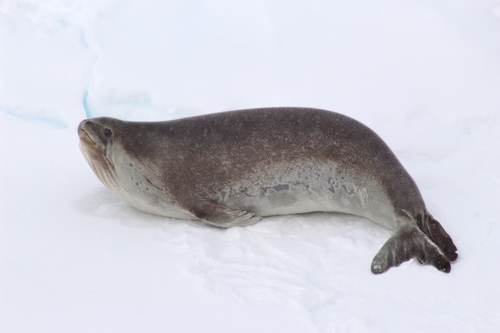
Ross Seal
Ommatophoca rossii
The ghost of the Antarctic pack ice, the Ross Seal is a rare and beautiful sight. With its massive, soulful eyes and a song that sounds like it's from another planet, it remains the most mysterious seal on Earth.
Quick Identification
Size
1.7 to 2.1 meters (5.6 to 6.9 feet) in length; weighing between 130 and 215 kg (285 to 475 lbs).
Colors
Dark brown to charcoal grey on the back, fading into a silvery-white belly; distinct streaks of grey or brown often run along the neck and sides.
Key Features
- Oversized dark eyes for deep-sea hunting
- Short, broad muzzle with a 'pug-like' appearance
- Smallest and slimmest of the Antarctic seals
- Shortest fur density of any pinniped species
- Highly complex, bird-like trilling vocalizations
When You’ll See Them
Behavior
The Ross Seal is arguably the most enigmatic marine mammal in the Southern Ocean. Unlike their more social cousins, these seals are largely solitary, spending the vast majority of their lives within the dense, inaccessible pack ice that surrounds Antarctica. They are known for a peculiar 'head-up' posture when approached; they will tilt their heads back, open their mouths wide, and emit a series of haunting, siren-like vocalizations that can sound more like electronic music than an animal call.
Because they live so far from human activity, Ross Seals have very little experience with people. They typically appear curious or indifferent rather than fearful, though they are much harder to spot than Weddell or Crabeater seals because they prefer thicker ice floes. They are exceptional divers, using those massive eyes to track prey in the dimly lit depths of the Antarctic waters.
EverydayEarth exclusive
Camera Tips
Capturing a Ross Seal on camera is the 'holy grail' for polar wildlife enthusiasts. Because their habitat is restricted to the Antarctic pack ice, you won't find these in a suburban backyard. For those on expedition vessels or research trips, the key is focusing on stable, thick ice floes rather than the loose, 'pancake' ice preferred by Crabeaters. Position your camera at a low angle near the water's edge of a floe, as Ross Seals have a low profile and look most majestic when framed against the horizon.
Since the Ross Seal is famous for its vocalizations, a camera with a high-quality internal microphone or an external mic attachment is essential. They produce 'thumping' and 'trilling' sounds that carry through the ice and water. If you are setting up a stationary trail camera on a floe, ensure it has a sturdy tripod or ice-anchor, as the wind and moving ice can easily shift your frame. Lithium batteries are an absolute requirement here; standard alkaline batteries will fail within minutes in the sub-zero temperatures.
Lighting in the Antarctic can be tricky due to the high reflectivity of the snow and ice. To avoid 'white-out' images, manually underexpose your shots by one or two stops or use a circular polarizer filter if your camera housing allows it. During the austral summer, you have 24-hour light, but the 'Golden Hour' lasts for several hours—this is the best time to capture the silver sheen of their unique, short fur. Avoid using a flash, as their oversized eyes are extremely sensitive to light and you may startle them.
Similar Species
Species that look similar or are commonly confused with Ross Seal.
Crabeater Seal
Crabeaters have a much longer, dog-like snout and live in larger social groups on loose ice.
Weddell Seal
Weddell Seals are much larger, have small heads relative to their bodies, and prefer 'fast ice' attached to the shore.
Leopard Seal
Leopard Seals have massive, reptilian-looking heads and a highly spotted coat; they are much more aggressive predators.
Frequently Asked Questions
Record Ross Seal at your habitat
Connect a camera to start building your own species record — AI identifies every visitor automatically.