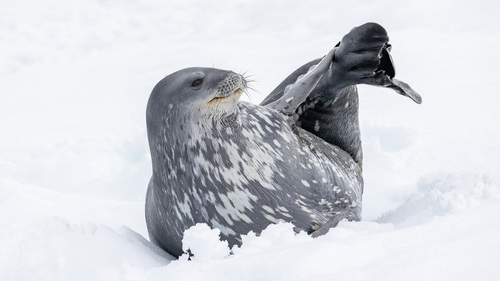
Weddell Seal
Leptonychotes weddellii
The ghost of the Antarctic ice, the Weddell Seal is a master of the deep, capable of diving over 600 meters while singing a chorus of otherworldly songs that echo through the frozen sea.
Quick Identification
Size
Length: 2.5–3.5 meters (8.2–11.5 ft); Weight: 400–600 kg (880–1,320 lbs)
Colors
Dark gray to black dorsal coat with silver-white and yellowish mottling on the belly; colors often fade to brown before the annual molt.
Key Features
- Relatively small head and short muzzle compared to body size
- Large, dark eyes and cat-like facial expression
- Plump, spindle-shaped body with heavy blubber
- V-shaped nostrils and small front flippers
When You’ll See Them
Behavior
Weddell Seals are remarkably docile and approachable, largely because they lack natural land predators in their Antarctic habitat. They spend a significant portion of their lives beneath the fast ice—ice that is attached to the shoreline—using their specialized teeth to grind away at ice to maintain breathing holes. This allows them to stay in protected waters where killer whales and leopard seals cannot easily reach them.
Socially, they are known for their complex and haunting underwater vocalizations, which include trills, whistles, and chirps that can be heard even through the ice. On the surface, they are often seen basking in the sun or sleeping deeply. During the breeding season, females gather in colonies on the ice to give birth, while males defend underwater territories near the breathing holes to secure mating rights.
EverydayEarth exclusive
Camera Tips
Capturing the Weddell Seal requires preparing for the most extreme conditions on Earth. For those stationed at Antarctic bases or visiting coastal sites, the best placement for a trail camera is near active 'tide cracks'—fractures in the ice caused by shifting tides. These are the natural doorways seals use to haul themselves out of the water. Position your camera approximately 2-3 feet off the ground, angled slightly downward to account for the seal's low profile when it is resting on the ice.
Battery management is the biggest challenge in sub-zero temperatures. Standard alkaline batteries will fail almost instantly; use high-capacity lithium batteries or an external power pack insulated with foam. If you are using a trigger-based setup, be aware that the high-reflectivity of the snow and ice can sometimes trick PIR sensors or cause severe overexposure. Setting your camera to a lower exposure value (EV -1.0 or -2.0) can help preserve the detail in the seal's mottled fur against the brilliant white background.
Because Weddell Seals are slow-moving on land and often sleep for hours at a time, traditional motion-triggering may result in thousands of identical frames. Consider using a 'Time Lapse' mode set to fire every 15-30 minutes during the peak daylight hours of the Antarctic summer. This will capture the fascinating process of a seal widening its breathing hole or the slow movement of a mother and pup. If you are aiming for video, ensure your camera has a fast recovery time, as the most interesting behavior—the 'worming' motion they use to move across the ice—is slow but rhythmic.
Lastly, keep lens fogging in mind. When moving your camera from a warm research hut to the freezing outdoors, allow it to acclimate inside a sealed dry bag to prevent internal condensation. Placing a few silica gel desiccant packets inside the camera housing is essential to keep the lens clear for those crisp, high-contrast shots of the seal's iconic 'smiling' face.
Similar Species
Species that look similar or are commonly confused with Weddell Seal.
Crabeater Seal
Lighter, more uniform coat color and a longer, pointed muzzle compared to the Weddell's blunt face.
Leopard Seal
Much larger, more reptilian head with a massive gape and a more slender, muscular body built for high-speed hunting.
Ross Seal
Smaller with much larger eyes and a very short muzzle; they are rarely seen on fast ice, preferring the pack ice.
Frequently Asked Questions
Record Weddell Seal at your habitat
Connect a camera to start building your own species record — AI identifies every visitor automatically.