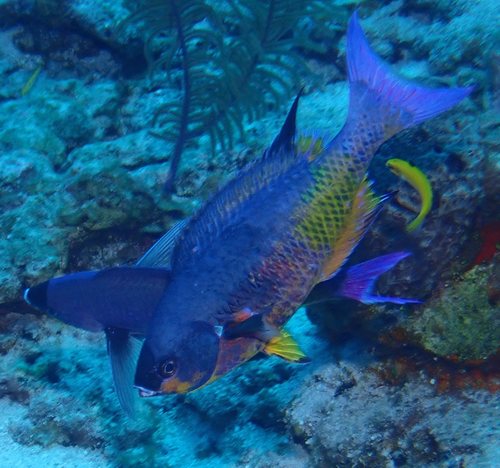
Creole Wrasse
Bodianus parrae
The Creole Wrasse is the 'purple cloud' of the Caribbean, a social and streamlined fish that brings vibrant color to the deep blue reef slopes.
Quick Identification
Size
20–30 cm (8–12 inches) in length
Colors
Adults are primarily deep purple or violet-blue. As they mature, they often develop a prominent yellow or orange-red wash on the rear half of their body and tail.
Key Features
- Streamlined, torpedo-shaped body
- Deep violet to purple coloration
- Lunate (forked) tail fin
- Yellowish wash on the posterior of older adults
When You’ll See Them
Sightings on EverydayEarth
Jul 3, 2026
A Creole Wrasse swims across the upper portion of the frame, showing its characteristic dark-colored tail against its lighter blue body. Numerous small Blue Chromis are scattered throughout the water column, darting between the coral heads. The reef itself is densely populated with various corals, including sea fans and plumes that sway rhythmically with the ocean current.
Jul 3, 2026
A variety of tropical fish are active above a healthy coral reef. A Creole Wrasse is prominent in the upper water column, displaying its characteristic dark-to-light color transition. A terminal phase Bluehead Wrasse with its signature blue head and black banding swims through the mid-ground, while several small Blue Chromis dart about in the open water above the corals. The soft corals and fans sway gently in the current.
Jul 3, 2026
A Creole Wrasse swims through the open water above a vibrant coral reef. Numerous small, blue reef fish are seen hovering near sea fans and coral structures in the background, while the larger wrasse moves across the upper portion of the frame.
Jul 3, 2026
A Creole Wrasse swims through the upper water column while several small Blue Chromis hover in a group just above the coral reef. The reef is active with various species of coral and sea fans swaying gently in the current.
Jul 3, 2026
A diverse coral reef scene teeming with life. A terminal phase male Bluehead Wrasse and a Creole Wrasse are seen swimming in the open water above the reef. Several small Blue Chromis are scattered throughout the scene, hovering near the safety of various coral species including sea fans, brain corals, and stony corals. The water is clear with bright afternoon sunlight filtering through.
Jul 3, 2026
A vibrant underwater scene shows a diverse array of reef fish. A Creole Wrasse swims steadily through the upper water column from left to right. Numerous small Blue Chromis dart around the center of the frame, while several Atlantic Sergeant Majors forage among the sea fans and coral outcroppings on the reef floor. The water is clear with light filtering down from the surface.
Geographic range
Where Does the Creole Wrasse Live?
Where Does the Creole Wrasse Live? This vibrant fish is a signature resident of the western Atlantic Ocean, where it thrives in clear, tropical waters. Its range begins in the northern reaches of the Florida Keys and the Bahamas, stretching through the entire Caribbean Sea and the Gulf of Mexico. Populations are also commonly found along the Central American coastline and as far south as the tropical waters of Brazil, making it one of the most widespread reef fish in the region.
Basemap © OpenStreetMap contributors
Behavior
These fish are protogynous hermaphrodites, meaning they begin life as females and can transition into males as they grow and the social hierarchy requires. They are generally peaceful and indifferent to humans, though they are quite fast and wary of sudden movements. At night, the schools disperse, and individual wrasses seek out small crevices or holes in the reef to sleep, sometimes secreting a mucous cocoon for protection.
EverydayEarth exclusive
Camera Tips
Capturing the Creole Wrasse requires an underwater camera setup, such as an AI-powered reef cam or a mounted action camera. Because these fish are mid-water dwellers, do not place your camera directly on the sand. Instead, mount it on a dock piling, a submerged sea wall, or a coral outcrop at a depth of 5 to 15 feet. Angle the lens slightly upward or toward the open water where the current is strongest, as this is where the wrasse schools congregate to feed on plankton.
Light is your biggest challenge under the sea. Creole Wrasse are most active during the brightest parts of the day when the sun can penetrate the water column to reveal their deep purple colors. If your camera settings allow, increase the shutter speed to at least 1/250; these are fast-moving fish, and their darting movements can easily result in motion blur. Using a red filter or adjusting the white balance for 'underwater' mode will help prevent the footage from looking overly green or blue.
To attract a school to your lens, look for 'pinch points' where tidal currents are funnelled, such as near a canal mouth or a gap in a reef. While they won't go for standard bait, they are naturally curious about bubbles or light reflections. Set your camera to record in high-frame-rate video or use a burst mode triggered by motion. Because they travel in large groups, a single trigger can capture dozens of individuals swirling in a mesmerizing purple cloud.
Similar Species
Species that look similar or are commonly confused with Creole Wrasse.
Frequently Asked Questions
Record Creole Wrasse at your habitat
Connect a camera to start building your own species record — AI identifies every visitor automatically.