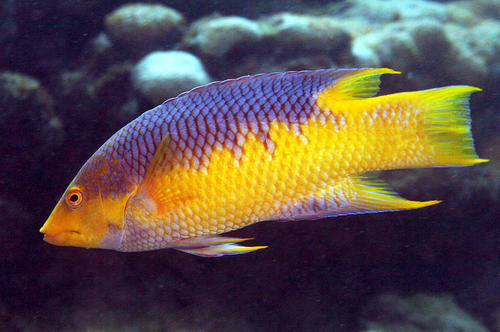
Spanish Hogfish
Bodianus rufus
With its stunning purple-and-gold coat, the Spanish Hogfish is the undisputed jewel of the Western Atlantic reefs. Whether acting as a reef 'doctor' or a bold predator, this colorful wrasse is a favorite for underwater observers.
Quick Identification
Size
Typically 20–28 cm (8–11 in) in length, though large adults can reach up to 40 cm (16 in).
Colors
Striking bicolor pattern with a purplish-blue or magenta upper body and a bright yellow lower body and tail; juveniles are mostly yellow with a purple patch on the head.
Key Features
- Distinctive horizontal split between purple top and yellow bottom
- Elongated, pointed snout with thick lips
- Notched caudal (tail) fin
- Continuous dorsal fin spanning most of the back
When You’ll See Them
Sightings on EverydayEarth
Apr 26, 2026
A vibrant Blue Chromis swims actively in front of large, waving sea fans on a coral reef wall. Later, a Spanish Hogfish enters from the bottom right, moving across the lower section of the frame. Other smaller fish can be seen darting through the water column in the background.
Apr 20, 2026
A vibrant reef scene filled with activity. Several Atlantic Blue Tangs and Caribbean Bluehead Wrasse in various life stages swim among the sea fans. A Spanish Hogfish is seen moving along the left side of the reef, while schools of Atlantic Sergeant Majors drift in the background water column.
Apr 19, 2026
A vibrant underwater scene at night, illuminated by artificial light. A Spanish Hogfish swims low across the reef floor, followed by a Bar Jack that glides through the center of the frame, showing its distinctive yellow tail. Several smaller, unidentified fish dart in and out of the crevices in the coral and around the large support pillars.
Geographic range
Where Does the Spanish Hogfish Live?
Native to the vibrant waters of the Western Atlantic Ocean, the Spanish Hogfish is a staple of tropical and subtropical reef systems. Its range extends from the warm coastlines of North Carolina and Bermuda, sweeping through the Caribbean Sea and the Gulf of Mexico, all the way down to the southern shores of Brazil. These fish are strictly marine dwellers, thriving in the intricate structures of coral reefs where they can find both food and shelter from larger predators.
Basemap © OpenStreetMap contributors
Recorded on EverydayEarth
Behavior
Spanish Hogfish are energetic and highly visible members of the reef community. During the day, they are constantly on the move, patrolling their territory for food. They are known for their intelligence and curiosity, often approaching divers or underwater cameras to investigate. Unlike many reef fish that school for protection, adults are typically solitary or found in small, loose groups near prominent reef structures.
One of their most fascinating social behaviors is seen in the juveniles, which act as 'cleaner fish.' They establish cleaning stations where larger fish, such as groupers or snappers, visit to have parasites and dead skin removed. As they mature, Spanish Hogfish transition from these helpful cleaners into formidable predators of the reef floor.
EverydayEarth exclusive
Camera Tips
To capture high-quality footage of the Spanish Hogfish, you will need a waterproof action camera or an AI-powered underwater housing. If you have a dock or a backyard with direct access to a tropical reef or sea wall, mount your camera at a depth of 2 to 5 meters. Angling the lens slightly upward can help capture the shimmering purple of their upper body against the natural light filtering through the surface.
Because these fish are highly curious, they are often attracted to any changes in their environment. Placing your camera near a 'cleaning station'—usually a prominent coral head or rock—is the best way to record their social interactions. You don't necessarily need bait, but a small amount of crushed shellfish placed near the camera can encourage them to stick around and show off their foraging behavior for the lens.
Lighting is crucial for marine photography. Spanish Hogfish are most active in the middle of the day when the sun is directly overhead, which provides the best natural color saturation. If you are filming in deeper water or under a shaded pier, consider using a red filter or a small underwater LED light to bring out the vibrant magenta and gold hues that often look dull or blue in deep-water footage.
Similar Species
Species that look similar or are commonly confused with Spanish Hogfish.
Frequently Asked Questions
Record Spanish Hogfish at your habitat
Connect a camera to start building your own species record — AI identifies every visitor automatically.