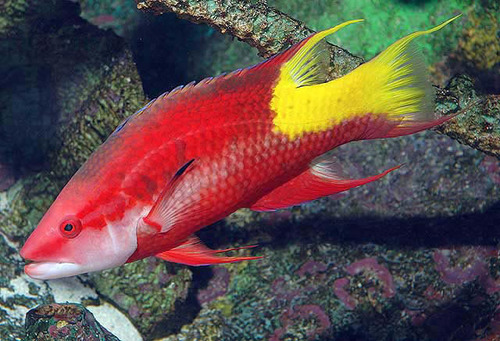
Spotfin Hogfish
Bodianus pulchellus
A vibrant jewel of the Atlantic reefs, the Spotfin Hogfish stands out with its stunning red-and-yellow gradient and a signature 'racing stripe.' Whether cleaning larger fish as a juvenile or patrolling the deep reef as an adult, this wrasse is a master of the coral landscape.
Quick Identification
Size
Typically ranges from 15 to 20 cm (6 to 8 inches), with a maximum recorded length of 28 cm (11 inches).
Colors
Distinctive tri-color pattern with a bright red head and upper body, a vibrant yellow tail and rear dorsal area, and a bold white horizontal stripe running along the midsection. A small black spot is visible on the pectoral fin base.
Key Features
- Horizontal white stripe from snout to tail
- Bright yellow posterior transition
- Black spot on the pectoral fin and dorsal fin
- Pointed snout with sharp terminal teeth
When You’ll See Them
Geographic range
Where Does the Spotfin Hogfish Live?
The Spotfin Hogfish is native to the tropical and subtropical waters of the Atlantic Ocean. Its primary range extends from the North Carolina coast in the United States, through the Caribbean Sea and the Gulf of Mexico, all the way down to southern Brazil. A secondary, isolated population has also been documented in the Eastern Atlantic around the island of São Tomé off the coast of West Africa.
Basemap © OpenStreetMap contributors
Behavior
The Spotfin Hogfish is a diurnal species, meaning it is most active during daylight hours when it can be seen darting between coral heads and rocky outcroppings. While adults are generally solitary and somewhat territorial about their preferred foraging patches, they are often found in the company of other reef fish. They have a curious nature and are known to follow larger bottom-feeding fish to snatch up small invertebrates stirred up from the sand.
Juveniles exhibit a fascinating 'cleaner' behavior, setting up stations where they pick parasites and dead tissue off larger fish, including groupers and snappers. As they mature into adults, their diet shifts and they become more independent. At night, they seek shelter in deep reef crevices or under ledges, where they remain dormant to avoid nocturnal predators like moray eels.
EverydayEarth exclusive
Camera Tips
To capture the Spotfin Hogfish on an underwater 'backyard' or dock camera, placement is everything. These fish are drawn to structure, so position your camera near coral heads, large sponges, or rocky ledges where they forage. If you are monitoring from a dock or seawall in a tropical location, look for areas with significant vertical relief or submerged debris, as these act as natural magnets for the species.
Because the Spotfin Hogfish often lives at depths where red light is absorbed by the water, using an external light source or a red filter is crucial for revealing their true colors. Without supplemental lighting, the brilliant red and yellow pigments will appear as dull shades of grey or brown. For the best results, use wide-angle settings to capture their movement against the reef, but ensure your camera's focus is set for mid-range (1-3 meters) to catch them as they inspect the lens.
High-frame-rate settings are recommended, as wrasses are known for their 'labriform' swimming style—using their pectoral fins to move in quick, jerky bursts. If you are using a baited camera for research, a small amount of crushed shellfish in a mesh bag can keep a Spotfin Hogfish in the frame for several minutes. They are particularly active during the mid-morning when the sun is high enough to penetrate the deeper sections of the reef.
Similar Species
Species that look similar or are commonly confused with Spotfin Hogfish.
Frequently Asked Questions
Record Spotfin Hogfish at your habitat
Connect a camera to start building your own species record — AI identifies every visitor automatically.