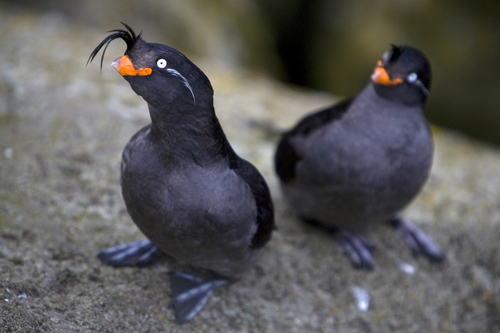
Crested Auklet
Aethia cristatella
With a whimsical forehead crest and the scent of fresh tangerines, the Crested Auklet is the North Pacific's most charismatic acrobat. These social seabirds form massive, swirling colonies that are a true wonder of the Bering Sea.
Quick Identification
Size
Length: 18–27 cm (7–11 in); Wingspan: 40–50 cm (16–20 in); Weight: 250–350 g (8.8–12.3 oz)
Colors
Uniform sooty-grey or charcoal plumage; bright orange-red bill (breeding); white plume streak behind the eye; black forehead crest
Key Features
- Forward-curving black forehead crest
- Bright orange-red bill with seasonal plates
- Thin white plume extending back from the eye
- Distinctive citrus or tangerine-like scent
When You’ll See Them
Geographic range
Where Does the Crested Auklet Live?
Native to the rugged North Pacific and the Bering Sea, the Crested Auklet is a true denizen of the subarctic. Its core range spans from the Aleutian Islands and the Pribilofs in Alaska across to the Kuril Islands and the Sea of Okhotsk in Russia. While they spend the majority of their lives on the open ocean, they return to these remote, rocky coastlines to breed in some of the largest bird colonies in the world.
Basemap © OpenStreetMap contributors
Behavior
The Crested Auklet is one of the most social seabirds in the Northern Hemisphere, famous for gathering in 'mega-colonies' that can number over a million individuals. During the breeding season, they exhibit a unique ritual known as 'ruff-sniffing,' where they bury their bills into the neck feathers of a mate to catch a whiff of their distinctive citrus-like scent. This tangerine aroma is actually a chemical defense used to repel ticks and other parasites.
These birds are master divers, using their wings to 'fly' underwater in pursuit of prey. They are incredibly vocal on their breeding grounds, creating a cacophony of barking and trumpeting sounds that can be heard from miles away. While they spend their winters at sea, their return to land in the spring is a spectacular event involving massive swirling flights over the nesting colonies.
EverydayEarth exclusive
Camera Tips
Because Crested Auklets nest in deep crevices within boulder fields and scree slopes, camera placement should focus on high-traffic 'staging' rocks where birds land before entering their burrows. Aim your AI camera at flat, prominent rocks near the colony's edge that show signs of heavy use, such as guano staining. A low-angle mount (12–18 inches off the ground) will best capture their forward-curling crests and the intricate 'ruff-sniffing' social behaviors that occur on the surface.
Since these birds inhabit high-latitude environments with unpredictable weather, ensure your camera has a high IP rating for moisture and wind resistance. Avoid using traditional food lures, as these can attract predators like foxes or gulls that threaten the colony. Instead, rely on the birds' natural social attraction; the movement and noise of the colony itself are the best triggers for your camera. If you are using a camera with a specific AI trigger, look for the 'swarming' behavior during the early morning hours.
Optimal timing for capture is during the breeding season from late May to July. During this window, the birds are most active on land during the 'evening social hour'—usually a few hours before sunset—when they gather on rocks to display. Set your camera to a high frame rate or burst mode to capture the fast-paced social interactions and the rapid wingbeats as they arrive from the sea. High-speed shutter settings are essential to avoid motion blur during their energetic displays.
Similar Species
Species that look similar or are commonly confused with Crested Auklet.
Frequently Asked Questions
Record Crested Auklet at your habitat
Connect a camera to start building your own species record — AI identifies every visitor automatically.