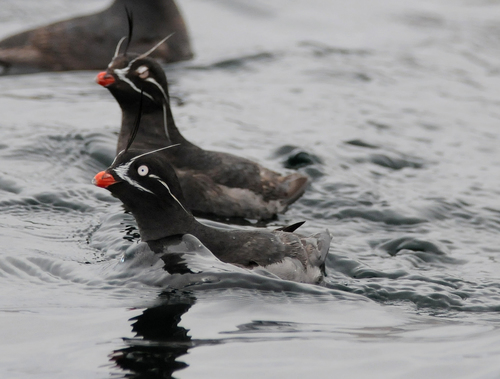
Whiskered Auklet
Aethia pygmaea
A tiny marvel of the North Pacific, the Whiskered Auklet is defined by its ornate facial plumes and mysterious nocturnal habits. These citrus-scented sailors thrive in the world's most turbulent waters, making them a prize find for any wildlife observer.
Quick Identification
Size
Length: 17-20 cm (6.7-7.9 in); Wingspan: 30-35 cm (11.8-13.8 in); Weight: 100-130 g (3.5-4.6 oz)
Colors
Slate-gray to charcoal body; breeding adults have three pairs of white facial plumes and a black forehead crest; orange-red bill with a white tip.
Key Features
- Three distinct long white plumes on each side of the face
- Forward-curving black forehead crest
- Very small, stocky 'spherical' body profile
- Bright orange-red bill with a pale bulbous tip
When You’ll See Them
Behavior
The Whiskered Auklet is a highly social but elusive seabird, spending the vast majority of its life at sea within the turbulent waters of the Aleutian and Kuril Islands. Unlike many other alcids, they are often found near 'tide rips'—areas where strong currents collide—to forage on concentrated plankton. They are famous among researchers for their 'citrus-like' scent, a social odor they produce during the breeding season that may help in mate recognition or individual health signaling.
On land, these birds are primarily crepuscular or nocturnal, arriving at their nesting colonies under the cover of darkness to avoid predation by larger gulls and eagles. They are cavity nesters, squeezing their tiny bodies into deep rock crevices or volcanic talus slopes. Despite their small size, they are incredibly hardy, navigating some of the roughest maritime environments on the planet with surprising agility.
EverydayEarth exclusive
Camera Tips
Capturing the Whiskered Auklet on camera is a specialized challenge due to their remote habitat and nocturnal land habits. If you are in a coastal Aleutian region, focus your camera placement on stable talus slopes or rocky cliff faces where small crevices are visible. Because these birds arrive at nesting sites in low light or total darkness, a camera with high-quality infrared (IR) or 'no-glow' LEDs is essential to capture clear images without startling the birds or attracting predators to the site.
Set your camera at a low angle, roughly 12 to 24 inches off the ground, pointed toward the entrance of a rock cavity. Since these birds are incredibly fast and small, use the fastest trigger speed available (0.2 seconds or less) and set the camera to 'burst mode' or 'rapid-fire' to take 3-5 photos per trigger. This increases your chances of getting a clear shot of their unique facial plumes as they scurry into their burrows.
Aleutian weather is notoriously harsh, so ensure your camera housing is rated for extreme moisture and high winds. Secure the camera to a heavy rock or a weighted tripod, as the gusts in their habitat can easily tip over standard equipment. Avoid using artificial lures or food; instead, look for 'whitewash' (guano) markings on rocks, which indicate high-traffic entry points to their nesting colonies. The best time for recording is during the peak breeding months of June and July when activity is at its highest.
Similar Species
Species that look similar or are commonly confused with Whiskered Auklet.
Frequently Asked Questions
Record Whiskered Auklet at your habitat
Connect a camera to start building your own species record — AI identifies every visitor automatically.