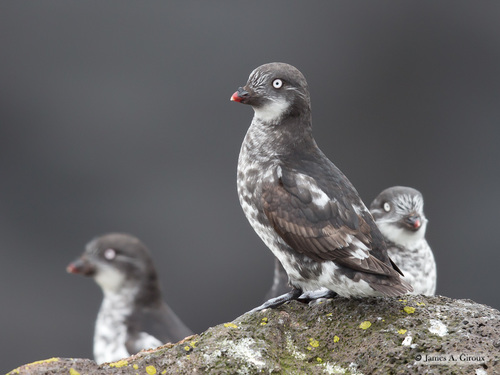
Least Auklet
Aethia pusilla
Meet the world's smallest auk, a tiny Arctic survivor that forms some of the largest bird colonies on the planet.
Quick Identification
Size
Length: 12-14 cm (5-6 inches); Wingspan: 25-30 cm (10-12 inches); Weight: 70-100 g (2.5-3.5 oz)
Colors
Slate-grey to black upperparts; white underparts with dark spotting; breeding adults have white facial plumes and a red bill.
Key Features
- Extremely small, sparrow-sized seabird
- Fine white facial feathers extending from the eye
- Short, stubby red bill with a pale tip
- Pale yellow iris giving a distinctive 'staring' look
When You’ll See Them
Geographic range
Where Does the Least Auklet Live?
Native to the northernmost reaches of the Pacific Ocean, the Least Auklet is a true icon of the Bering Sea. Its range is centered around the remote islands of Alaska and eastern Siberia, with massive breeding populations found on the Aleutian, Pribilof, and Diomede Islands. During the winter months, these hardy survivors migrate southward just enough to stay in ice-free waters, often reaching as far as the coastal waters of northern Japan.
Basemap © OpenStreetMap contributors
Behavior
Least Auklets are social powerhouses, nesting in colonies that can number in the millions. During the breeding season, they transform rocky talus slopes into a bustling metropolis of sound and activity. They are famous for their 'social chatter,' a high-pitched cacophony that can be heard from a distance as thousands of birds return from the sea simultaneously. Unlike many other seabirds, they are quite comfortable walking (and tripping) over jagged rocks to reach their underground nesting crevices.
In the water, these birds are exceptionally agile. They use their short, powerful wings to 'fly' underwater, diving to depths of up to 15 meters to hunt for tiny crustaceans. While they are generally wary of humans, their sheer numbers in colonies like those on St. Lawrence Island mean they often ignore stationary observers. At sea, they are frequently seen in massive rafts, bobbing on the waves before diving in unison if a predator or a boat approaches.
EverydayEarth exclusive
Camera Tips
Capturing the Least Auklet requires a specialized approach because they do not visit traditional backyards; instead, they inhabit rugged, wind-swept island slopes. If you are placing a camera in a colony area, focus on 'landing rocks'—prominent, flat-topped stones that stand out from the surrounding scree. These serve as social hubs where birds land to display and vocalize before heading to their nests. Mount your camera low, ideally only 12-18 inches off the ground, to capture their tiny stature at eye level.
Because the Arctic environment is notoriously harsh, use a camera housing with high weather resistance. Salt spray and heavy fog can cloud lenses quickly, so a rain hood or a periodic lens cleaning is essential. For the best action shots, set your camera to 'Burst Mode' or high-speed video. These birds are incredibly fast and erratic in flight; a high frame rate is the only way to avoid a gallery of blurry wings as they dive into the rocks.
Timing is everything with this species. They are most active at the colony during the early morning and late evening 'swarming' periods. Use a fast shutter speed (at least 1/1000s) if your camera allows manual overrides, as the Arctic light can be surprisingly flat, making it hard for autofocus to lock onto a small, dark bird. Avoid using artificial lures or baits, as these birds are strictly planktivorous and will not be attracted to seeds or suet; their natural social curiosity is the best 'lure' you have.
Similar Species
Species that look similar or are commonly confused with Least Auklet.
Frequently Asked Questions
Record Least Auklet at your habitat
Connect a camera to start building your own species record — AI identifies every visitor automatically.