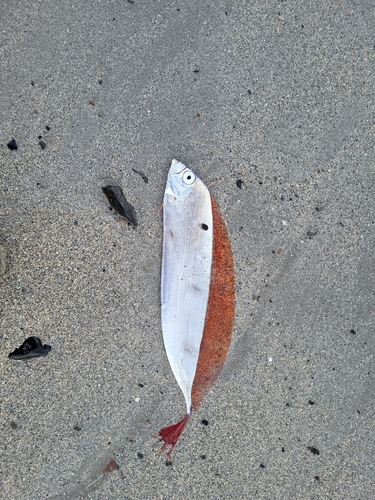
Dealfish
Trachipterus arcticus
A shimmering phantom of the North Atlantic, the Dealfish is a rare, ribbon-like marvel known for its brilliant silver skin and vivid crimson fins. This elusive deep-sea dweller is one of the ocean's most mysterious residents, seldom seen unless cast ashore by the sea's powerful storms.
Quick Identification
Size
Typically 1.5–2.5 m (5–8 ft) in length, reaching a maximum of 3 m (9.8 ft); weight generally ranges from 10–20 kg (22–44 lbs).
Colors
Brilliant, mirror-like silver or chrome body, sometimes with subtle dark spots; fins are typically a vibrant crimson or orange-red.
Key Features
- Elongated and highly compressed ribbon-shaped body
- Striking crimson dorsal fin spanning the entire length of the back
- Large, prominent eyes adapted for low-light deep-sea visibility
- Small, upward-angled protrusible mouth
When You’ll See Them
Geographic range
Where Does the Dealfish Live?
The Dealfish is a native of the North Atlantic Ocean, primarily found in the cold, deep waters stretching from Iceland and Norway down toward the British Isles and the North Sea. While its core range is centered in the northern latitudes of Europe and the Arctic circle, occasional sightings have been recorded as far south as the Mediterranean Sea. This species is truly a creature of the open sea, rarely venturing near the continental shelf unless pushed by unusual currents or internal illness.
Basemap © OpenStreetMap contributors
Behavior
The Dealfish is a mysterious and solitary inhabitant of the mesopelagic zone, the ocean's 'twilight zone.' It employs a unique method of swimming known as amiiform locomotion, where it keeps its long, ribbon-like body relatively straight while undulating its crimson dorsal fin to glide through the water. This allows it to hover nearly motionless in the water column, likely to avoid detection by predators while it waits for prey to drift within reach.
Because they live at such extreme depths, they are rarely observed alive by humans. Most of what we know about their behavior comes from individuals that have washed ashore following heavy storms or those accidentally caught in deep-sea research nets. They lack a swim bladder and have a fragile, gelatinous skeleton, making them highly sensitive to the pressure changes that occur if they are forced toward the surface.
EverydayEarth exclusive
Camera Tips
Capturing a Dealfish on an AI-powered camera is an extraordinary challenge because they reside in the deep ocean, far beyond the reach of standard backyard setups. To have any chance of seeing one, you would need to deploy a specialized underwater 'drop cam' or a deep-sea ROV (Remotely Operated Vehicle). These cameras must be housed in pressure-resistant casings capable of withstanding depths of at least 200 to 500 meters. The best locations are along deep-water drop-offs or underwater canyons off the coasts of Scotland or Norway.
If you are setting up an underwater rig, avoid using traditional white light, which can be blinding and frightening to deep-sea creatures. Instead, use a subtle blue or green LED light lure. Many deep-sea organisms are attracted to bioluminescence, and a faint, pulsing light can pique the curiosity of a passing Dealfish. Ensure your camera is set to a high trigger sensitivity and a long recording duration, as these fish tend to drift slowly rather than darting quickly through the frame.
For those without deep-sea equipment, the only other way to 'catch' a Dealfish on camera is by monitoring the shoreline after a massive North Atlantic gale. Placing a trail camera on a tripod overlooking the high-tide line in areas like the Shetland Islands or the Norwegian coast can sometimes capture rare 'strandings.' Set the camera to time-lapse mode during the winter months when these strandings are most common; the silver skin of a Dealfish reflects light so strongly that it will stand out even in the dim light of a winter morning.
Similar Species
Species that look similar or are commonly confused with Dealfish.
Frequently Asked Questions
Record Dealfish at your habitat
Connect a camera to start building your own species record — AI identifies every visitor automatically.