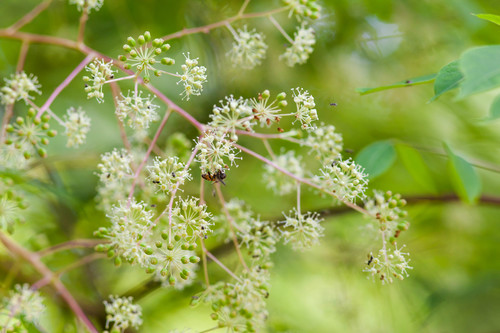
devil's walkingstick
Aralia spinosa
A prehistoric-looking native shrub, the devil's walkingstick is a magnet for pollinators and a fortress for songbirds, easily identified by its viciously spiny trunk and massive leaf canopy.
Quick Identification
Size
Typically 3–8 meters (10–26 feet) tall; compound leaves can reach 1.2 meters (4 feet) in length
Colors
Gray-brown bark with sharp tan spines; bright green foliage turning yellow or bronze in fall; creamy white flowers; dark purple to black berries
Key Features
- Trunk and leaf stalks covered in sharp, straight spines
- Massive, twice or thrice compound leaves forming a flat-topped canopy
- Huge umbrella-like clusters of white flowers appearing in late summer
- Bright pinkish-red fruit stalks holding dark purple berries
When You’ll See Them
Geographic range
Where Does the devil's walkingstick Live?
This distinctive woody plant is a native treasure of the eastern and southeastern United States. It flourishes from the mid-Atlantic states and southern New England down through the Gulf Coast and across into eastern Texas and Oklahoma. While it is a true North American original, it is also occasionally cultivated as an ornamental curiosity in temperate climates across Europe for its dramatic, spiny appearance.
Basemap © OpenStreetMap contributors
Behavior
The devil's walkingstick is a deciduous large shrub or small tree known for its "architectural" growth habit. It often grows in colonial thickets, spreading via underground runners (rhizomes). While it looks like a simple stick in the winter, it explodes in the spring with some of the largest leaves of any temperate plant in North America, creating a tropical, prehistoric aesthetic in the forest understory.
As a wildlife resource, it is a powerhouse. In mid-to-late summer, when many other nectar sources have faded, it produces massive panicles of white flowers that attract a dizzying array of pollinators. By autumn, these transform into heavy clusters of juice-filled berries. Because of its intense thorniness, it also provides excellent nesting protection for small birds, acting as a natural fortress against climbing predators like neighborhood cats or raccoons.
EverydayEarth exclusive
Camera Tips
Capturing the devil's walkingstick on camera is less about the plant itself and more about the incredible wildlife traffic it generates. To get the best shots, mount your camera on a nearby tree or a sturdy stake, aiming it at the flower or berry clusters. Since these clusters usually sit at the top of the plant, you may need to elevate your camera 5 to 8 feet off the ground. Angle the lens slightly downward to capture birds as they land on the pinkish fruit stalks to feed.
Late summer (July and August) is the best time to record pollinator activity. Use a camera with a high-speed trigger or video capability to capture the frantic movement of swallowtail butterflies, honeybees, and flower flies. If your camera has a macro or close-up setting, this is the time to use it. The sheer volume of insects on a single flower head is a spectacular sight for any backyard naturalist.
In the fall, transition your focus to the berries. This is a prime spot to catch fruit-eating birds like Northern Cardinals, Gray Catbirds, and various thrushes. Because these birds are often fast and skittish, set your camera to a multi-shot burst mode. The bright pink stalks against the dark purple berries provide excellent contrast, making for some of the most colorful shots you'll get all season. Avoid using heavy infrared flash at night if you are close to the foliage, as the broad leaves can cause significant light bounce-back and overexpose the image.
Similar Species
Species that look similar or are commonly confused with devil's walkingstick.
Japanese Angelica Tree
An invasive lookalike that blooms later and has flowers on a central axis, whereas the native species has a distinct central stem in the flower cluster.
Hercules' Club
Has thicker, corky warts on the trunk rather than slender spines, and the leaves are smaller and only once-compound.
Elderberry
Produces similar dark berry clusters but lacks the vicious spines and has much smaller, simpler compound leaves.
Frequently Asked Questions
Record devil's walkingstick at your habitat
Connect a camera to start building your own species record — AI identifies every visitor automatically.