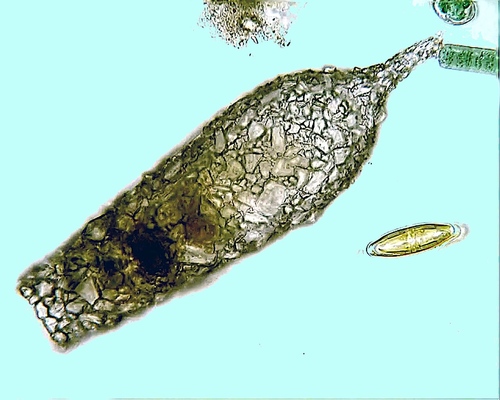
Difflugia acuminata
Cylindrifflugia acuminata
Meet the microscopic mason of the pond world. Difflugia acuminata builds its own protective armor out of tiny grains of sand, roaming the underwater silt of your backyard pond.
Quick Identification
Size
150-400 micrometers (0.006-0.015 inches) in length
Colors
Translucent body; shell (test) color depends on gathered materials, ranging from sandy brown to grey or amber
Key Features
- Elongated, vase-shaped shell (test) made of mineral grains
- Distinctive pointed 'horn' or spine at the aboral end
- Single circular opening for pseudopods
- Finger-like, clear lobopodia used for movement
When You’ll See Them
Geographic range
Where Does the Difflugia acuminata Live?
This species is a cosmopolitan inhabitant of freshwater ecosystems across nearly every continent, with the exception of Antarctica. It is widely distributed throughout North America, Europe, and Asia, thriving in both pristine mountain lakes and nutrient-rich suburban garden ponds. Its ability to form resilient cysts allows it to be dispersed by wind or transported on the damp feathers of migratory water birds, ensuring its presence in almost any permanent body of standing water.
Basemap © OpenStreetMap contributors
Behavior
Movement is slow and deliberate. The organism extends finger-like projections called lobopodia through the opening (pseudostome) at the base of its shell. These act as both legs to pull the shell along the substrate and as sensory organs to detect food. While they are solitary hunters, they are often found in high concentrations in areas rich in organic 'marine snow' or biofilm. They do not interact with humans directly, but they are essential players in the microscopic food web, keeping bacterial populations in check.
EverydayEarth exclusive
Camera Tips
For high-quality captures, use a slide with a shallow well to allow the amoeba room to move its shell. Since these organisms are semi-translucent, lighting is your most important setting. Use 'Darkfield' illumination if your camera supports it; this will make the sand grains in the Difflugia's shell sparkle against a dark background, highlighting the architectural detail. If using standard 'Brightfield' light, keep the intensity low to avoid washing out the delicate, clear pseudopods.
Baiting can be done in a petri dish by adding a few drops of a concentrated algae culture or a single grain of crushed fish food. Within a few hours, Difflugia will often crawl toward the food source. Patience is key, as their movement is measured in micrometers per minute. Set your camera to time-lapse mode, capturing one frame every 5–10 seconds, to create a stunning video of this microscopic mason navigating its environment. Ensure the water sample remains cool, as the heat from microscope bulbs can quickly dehydrate or kill the specimen.
Similar Species
Species that look similar or are commonly confused with Difflugia acuminata.
Difflugia oblonga
Lacks the sharp, pointed aboral spine found in D. acuminata, typically having a more rounded base.
Arcella vulgaris
Builds a smooth, circular, chitinous shell that looks like a transparent doughnut rather than a sandy vase.
Centropyxis aculeata
Has a flatter, more pancake-like shell with several spines around the edges rather than one single spine at the top.
Frequently Asked Questions
Record Difflugia acuminata at your habitat
Connect a camera to start building your own species record — AI identifies every visitor automatically.