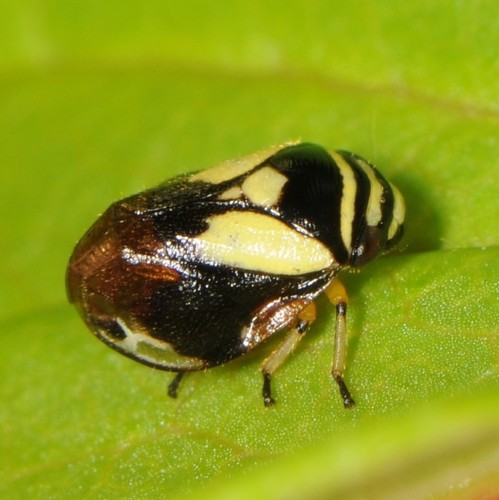
Dogwood Spittlebug
Clastoptera proteus
A master of the 'cuckoo spit' disguise, the Dogwood Spittlebug is a vibrant, jumping gem of the North American garden. While the young hide in bubbles, the adults sport striking yellow stripes that make them a favorite for macro-photographers.
Quick Identification
Size
Adults are tiny, measuring 3.5–4.5 mm (0.14–0.18 inches) in length.
Colors
Deep black or dark brown body with two prominent yellow or orange transverse stripes on the pronotum and distinct yellow spots on the wings.
Key Features
- Broad, oval, frog-like body shape
- Two bright yellow horizontal stripes on the thorax
- Nymphs produce a characteristic white bubbly 'spittle' mass
- Large, prominent eyes on the side of the head
When You’ll See Them
Geographic range
Where Does the Dogwood Spittlebug Live?
The Dogwood Spittlebug is a native inhabitant of North America, where its presence is closely tied to the distribution of its namesake host plants. It is most commonly encountered throughout the Eastern and Central United States, ranging from the Atlantic coast westward through the Great Lakes region and into the Great Plains. In Canada, populations are frequently spotted in the southern reaches of Ontario and Quebec, following the warmer temperate forest zones. While they are less common in the arid West, they thrive in any suburban or wild landscape where dogwoods have been planted or occur naturally.
Basemap © OpenStreetMap contributors
Behavior
The Dogwood Spittlebug is best known for the unique defensive strategy of its nymphs. The young insects secrete a fluid from their hind end that they whip into a soapy, bubbly foam using their legs. This 'cuckoo spit' serves multiple purposes: it hides the vulnerable nymph from predators like birds and spiders, provides a moist microclimate to prevent their soft bodies from drying out, and acts as a thermal blanket against temperature shifts.
As adults, these insects are commonly referred to as froghoppers due to their remarkable jumping ability. When threatened, they use powerful hind legs to launch themselves many times their body length into the air. Unlike many other garden insects, they are quite specialized, spending most of their life cycle on or near their host plants where they feed on nutrient-poor xylem sap. They are generally solitary but can be found in high densities on a single dogwood shrub during peak summer months.
EverydayEarth exclusive
Camera Tips
Capturing the Dogwood Spittlebug requires a shift in strategy compared to larger backyard visitors. Because they are so small, a standard trail camera may struggle to trigger or focus. For the best results, use a dedicated macro-lens setup or a high-resolution backyard 'nature cam' positioned very close—within 6 to 12 inches—of a dogwood branch. Look for the 'spittle' foam first; these white bubbly masses are easy for an AI camera to detect and serve as a guaranteed sign that a nymph is present inside.
To photograph the colorful adults, focus your camera on the upper surfaces of dogwood leaves or the tender new growth of the stems during the sunniest part of the day. They are most active when it is warm, often basking in the sun to gain energy for their high-powered jumps. Avoid using heavy flashes, which can wash out the delicate yellow markings on their dark bodies; natural, diffused sunlight is your best friend for capturing their high-contrast patterns.
Placement is key. Instead of mounting a camera on a large tree trunk, use a flexible tripod (like a GorillaPod) to wrap around a dogwood limb. Aim the lens at a cluster of leaves where you have previously seen spittle or adult activity. If your camera has a 'time-lapse' mode, this is an excellent way to capture the slow growth of the spittle mass or the emergence of the adult from its final nymphal skin, a process that is otherwise difficult to trigger with motion sensors.
Similar Species
Species that look similar or are commonly confused with Dogwood Spittlebug.
Frequently Asked Questions
Record Dogwood Spittlebug at your habitat
Connect a camera to start building your own species record — AI identifies every visitor automatically.