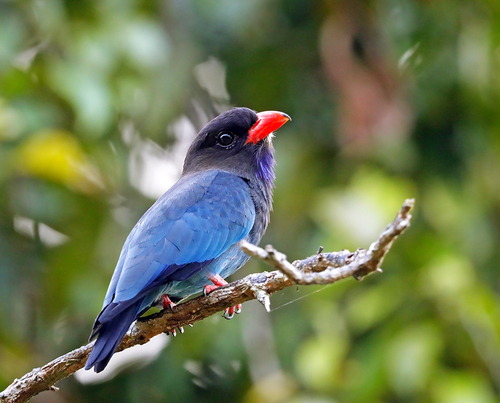
Dollarbird
Eurystomus orientalis
The Dollarbird is a master of the skies, named for the shimmering 'silver dollars' on its wings. A colorful summer visitor, it brings a touch of tropical brilliance to backyards and forest edges alike.
Quick Identification
Size
25–30 cm (10–12 in) long; 50–60 cm (20–24 in) wingspan; 120–200 g (4.2–7 oz)
Colors
Dark turquoise-blue to olive-brown body, bright orange-red bill and legs, with distinct silvery-white circular wing patches visible in flight
Key Features
- Vibrant orange-red beak and feet
- Distinctive pale blue or white 'coin' spots on the wings in flight
- Broad-headed silhouette with a short, thick neck
- Frequent perching on high, exposed dead branches
When You’ll See Them
Geographic range
Where Does the Dollarbird Live?
The Dollarbird is native to a vast stretch of the Old World, originating across East Asia and Oceania. Its core range extends from the Russian Far East and Japan, through China and the Indian subcontinent, down into Southeast Asia, and across to Australia and the Solomon Islands. These birds are notable migrants; populations in the northern and southern extremes of their range travel to the tropical regions of Indonesia and New Guinea to spend the winter months.
Basemap © OpenStreetMap contributors
Behavior
The Dollarbird is the only member of the roller family found in Australia and is celebrated for its spectacular aerial displays. These birds are 'perch hunters,' spending long periods sitting motionless on high, dead branches or power lines. From these vantage points, they scan the sky for large flying insects. When prey is spotted, they launch into the air with powerful, graceful wingbeats to snatch the insect mid-flight.
During the breeding season, they live up to their 'roller' name by performing dramatic swoops, rolls, and dives to defend their territory or attract a mate. They are highly vocal, especially at dawn and dusk, emitting a repetitive, raspy 'kak-kak-kak' call that can be heard from a significant distance. While they are generally solitary or seen in pairs, they are quite bold and will often return to the same favorite perch day after day.
EverydayEarth exclusive
Camera Tips
To capture high-quality footage of a Dollarbird, you must think vertically. These birds rarely spend time on the ground, so a camera mounted at eye level will likely miss them. Instead, identify a high, exposed 'scout' branch—ideally a dead limb on a tall tree or a prominent fence post—and mount your camera 3 to 5 meters high, angled upward. They have high site fidelity, meaning if you see one on a specific branch today, it will likely return to that exact spot tomorrow.
Because Dollarbirds are aerial hunters, they aren't attracted to birdseed. However, you can attract them indirectly by maintaining a 'wild' area in your garden that supports large insects like beetles and cicadas. Avoid using broad-spectrum pesticides, as a healthy population of large flying insects is the best lure for this species. If you have a large property, installing a nesting box with a 60-70mm entry hole high in a tree can encourage them to stay within range of your camera during the breeding months.
For the best visual results, set your camera's trigger speed to the fastest available setting. Their flight is rapid and erratic; a slow trigger will result in a blurry tail or an empty frame. Use high-frame-rate video settings (60fps if possible) to capture the moment they launch into a roll. Positioning your camera so the morning sun is behind it will highlight the iridescent turquoise of their feathers, which can otherwise look quite dark or muddy in shadows or harsh midday light.
Similar Species
Species that look similar or are commonly confused with Dollarbird.
Frequently Asked Questions
Record Dollarbird at your habitat
Connect a camera to start building your own species record — AI identifies every visitor automatically.