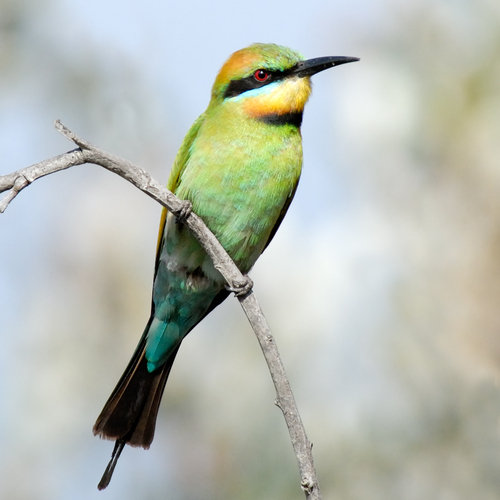
Rainbow Bee-eater
Merops ornatus
A master of the air, the Rainbow Bee-eater dazzles with its kaleidoscopic plumage and incredible aerial hunting skills. Watch as this emerald acrobat turns your backyard into a theater of precision flight.
Quick Identification
Size
Length: 23–28 cm (9–11 in) including tail streamers; Wingspan: ~30 cm (12 in); Weight: 20–33 g (0.7–1.1 oz)
Colors
Brilliant green body with bronze crown, golden-yellow throat with a black 'gorget' band, blue rump, and black tail with two long streamers.
Key Features
- Long, slender black bill slightly curved downward
- Two distinct wire-like tail streamers extending from the center of the tail
- A bold black 'bandit mask' stripe through the eye
- Vibrant rufous underwings visible only in flight
When You’ll See Them
Geographic range
Where Does the Rainbow Bee-eater Live?
The Rainbow Bee-eater is primarily native to the Australian continent, where it is found across almost the entire mainland and many offshore islands. As a migratory species, southern populations move north during the Australian winter, expanding their reach into Papua New Guinea, eastern Indonesia, and occasionally as far as the Solomon Islands. Because they thrive in both arid interiors and lush coastal fringes, they are one of the most widely distributed and recognizable seasonal visitors in the Australasian region.
Basemap © OpenStreetMap contributors
Behavior
Rainbow Bee-eaters are high-energy aerial insectivores known for their graceful, undulating flight patterns. They spend much of their day 'sallying' from high vantage points like dead branches or power lines. When they spot a flying insect, they launch into a precision strike, snatching the prey mid-air with an audible snap of the beak. They are remarkably skilled at handling stinging insects; after catching a bee or wasp, they return to their perch and repeatedly strike the insect's tail against the wood to remove the stinger and neutralize the venom before eating it.
These birds are highly social and are often seen in small flocks, particularly during migration. Unlike most birds that nest in trees, Rainbow Bee-eaters are burrowers. They use their beak and feet to excavate long tunnels—up to a meter deep—into sandy banks or even flat ground. They are generally bold and comfortable around human habitation, often frequenting suburban parks and gardens where tall trees and open spaces provide ideal hunting grounds.
EverydayEarth exclusive
Camera Tips
To capture the stunning iridescence of the Rainbow Bee-eater, your best strategy is to focus on their preferred hunting 'sallying' perches. Look for exposed, dead branches or low-hanging wires that overlook an open area or a water source. Mount your camera 5 to 8 feet off the ground, angled slightly upward toward a clean branch that offers a clear silhouette against the sky. Because these birds are lightning-fast, use a camera with a high-speed trigger or set it to record short 4K video clips to ensure you catch the moment of impact when they return to the perch to de-sting their prey.
During the breeding season (typically spring and summer), you can find them near their nesting burrows in sandy embankments or flat, sandy clearings. Placing a camera on a short tripod just 12-18 inches off the ground near a known burrow entrance can provide incredible intimate shots of their social interactions and 'helper' birds assisting the parents. Always maintain a respectful distance with your camera setup to ensure you do not discourage the birds from returning to the nest.
While they won't be lured by traditional birdseed, you can attract them indirectly by maintaining a 'pollinator-friendly' garden. Planting native flowering species like Grevilleas or Bottlebrushes draws in the bees and wasps they hunt. A birdbath or a garden pond is also a great draw, as they often swoop down to sip water on the wing. Set your camera's shutter speed to at least 1/2000th of a second if the light allows, as their colors are most spectacular when the motion is frozen in bright, direct sunlight.
Similar Species
Species that look similar or are commonly confused with Rainbow Bee-eater.
Sacred Kingfisher
Smaller and stockier with a much thicker, straight bill and lacks the long tail streamers of the bee-eater.
Dollarbird
Much stockier with a bright red, broad bill and distinctive white 'dollar' spots on the wings visible during flight.
Forest Kingfisher
Has a deeper blue back and a prominent white spot in front of the eye, with a much heavier bill.
Frequently Asked Questions
Record Rainbow Bee-eater at your habitat
Connect a camera to start building your own species record — AI identifies every visitor automatically.