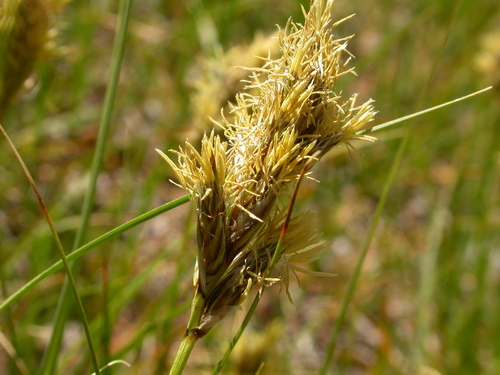
Douglas' sedge
Carex douglasii
A resilient survivor of the American West, Douglas' sedge turns harsh, alkaline soils into thriving green mats. This drought-tolerant native is a cornerstone of high-desert ecosystems and a favorite hideout for micro-wildlife.
Quick Identification
Size
Grows 10 to 30 cm (4 to 12 inches) tall, often forming low, dense mats via underground rhizomes.
Colors
Bright green to yellowish foliage; flowering heads transition from pale green to straw-colored or golden-brown.
Key Features
- Creeping rhizomes that form thick colonies
- Distinctly triangular stems (culms)
- Dense, egg-shaped flower clusters (inflorescences)
- Dioecious habit, with male and female flowers usually on separate plants
- Tolerant of highly alkaline and saline soils
When You’ll See Them
Geographic range
Where Does the Douglas' sedge Live?
Douglas' sedge is a quintessential plant of Western North America, native to a vast region stretching from British Columbia and Manitoba in Canada down through the Western United States to Northern Mexico. It is most densely populated within the Great Basin, the Rocky Mountains, and the high plains of the interior West. It thrives in the rain shadow of major mountain ranges where dry, open habitats are common.
Basemap © OpenStreetMap contributors
Behavior
Douglas' sedge is a hardy, colony-forming perennial that functions as a crucial stabilizer for soil in arid environments. Unlike many plants that struggle in harsh conditions, this species spreads vigorously through a network of creeping underground stems called rhizomes. This allows it to create dense, sod-like mats that prevent erosion and capture moisture in sandy or wind-swept areas. It is particularly known for its ability to thrive in 'problem' soils where high salt or alkaline content would kill less adapted species.
As a dioecious plant—meaning individual plants are typically either all-male or all-female—it relies on the wind for pollination. While it lacks the movement of wildlife, it is a hive of biological activity; its low-growing structure provides essential thermal cover for ground-nesting insects and small reptiles. In the ecosystem, it acts as a primary producer and a pioneer species, often being the first to reclaim disturbed roadsides or dry lake beds.
EverydayEarth exclusive
Camera Tips
Documenting Douglas' sedge with an AI-powered camera requires a ground-level approach. To capture the plant's unique 'sedge' architecture, mount your camera on a short stake or directly on the ground, aiming for a lens height of about 6 inches. This low angle allows the camera to capture the triangular shape of the stems and the texture of the flowering heads against the horizon, which helps AI identification tools distinguish the plant from surrounding grasses.
Because this species is a magnet for 'micro-wildlife,' consider using a camera with a close-focus or macro lens setting. While the sedge itself is stationary, the dense mats it forms are highways for beetles, spiders, and small lizards. Setting your camera to a higher trigger sensitivity or using time-lapse mode can reveal the hidden world of insects that rely on Douglas' sedge for food and shelter. If you are tracking the plant's growth, a photo taken once every 24 hours can create a stunning seasonal record of its transition from spring green to summer gold.
For the highest quality images, time your captures for the 'golden hour'—the hour after sunrise or before sunset. The low-angled light catches the papery scales of the seed heads, making them stand out with a translucent, golden quality. During the peak season of May through August, ensure your camera lens is clean of dust, as the dry environments where Douglas' sedge grows are often windy. Avoid placing the camera in deep shade; this species loves full sun, and your images will have better color accuracy and sharpness in bright, natural light.
Similar Species
Species that look similar or are commonly confused with Douglas' sedge.
Field Sedge
Field sedge (Carex praegracilis) has darker, almost blackish rhizomes and usually prefers slightly moister sites than Douglas' sedge.
Needleleaf Sedge
Carex duriuscula is much smaller, with narrower leaves and smaller flower clusters, often growing in drier, more upland shortgrass prairies.
Frequently Asked Questions
Record Douglas' sedge at your habitat
Connect a camera to start building your own species record — AI identifies every visitor automatically.