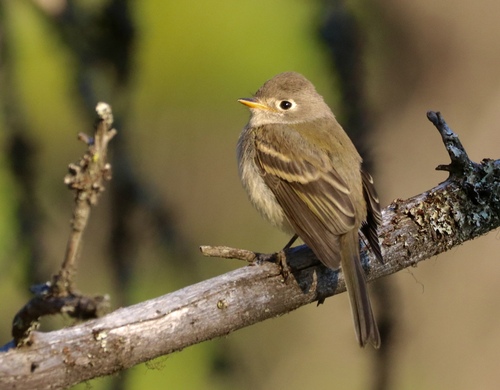
Dusky Flycatcher
Empidonax oberholseri
A master of the mountain brush, the Dusky Flycatcher is a subtle beauty known for its acrobatic aerial hunts and rhythmic tail flicks. This high-altitude specialist brings a touch of wild elegance to western gardens and thickets.
Quick Identification
Size
Length: 13-15 cm (5.1-5.9 in); Wingspan: 20-22 cm (7.9-8.7 in); Weight: 8-12 g (0.28-0.42 oz)
Colors
Grayish-olive upperparts, whitish to pale yellow underparts, two white wing bars, and a conspicuous white eye-ring.
Key Features
- Distinct white eye-ring and two pale wing bars
- Short, triangular bill with a pale yellowish base
- Longish tail that frequently flicks upward
- Short primary projection where wing tips don't extend far down the tail
When You’ll See Them
Geographic range
Where Does the Dusky Flycatcher Live?
The Dusky Flycatcher is a native of Western North America, with a breeding range that stretches from the interior of British Columbia and Alberta through the Rocky Mountains and Great Basin of the United States. As a migratory species, it travels south for the winter, settling in the highlands of Mexico and parts of Northern Central America. It is a specialist of the western montane regions, rarely straying far toward the eastern plains or the immediate Pacific coast during the nesting season.
Basemap © OpenStreetMap contributors
Behavior
The Dusky Flycatcher is a model of patience and precision. Typically found in the brushy understory of mountain slopes or open coniferous forests, this bird spends much of its day perched upright on exposed twigs. From these vantage points, it scans the air for flying insects, launching into sudden, acrobatic loops to snap up prey before returning—often to the exact same branch. This "perch-and-sally" foraging style is a hallmark of the tyrant flycatchers.
Socially, these birds are quite solitary and highly territorial during the breeding season. Males are persistent singers, using a multi-part, burry song to mark their boundaries. While they are not particularly shy around humans, their cryptic coloration and preference for shrubby cover make them easy to overlook. One of their most helpful identification cues is a frequent, gentle upward flick of the tail while perched.
EverydayEarth exclusive
Camera Tips
To capture high-quality footage of a Dusky Flycatcher, you need to think like a hunter. These birds prefer 'hunting perches'—dead lower branches of shrubs or small trees that offer a clear view of an open space. Set your AI-powered camera 4 to 6 feet off the ground, aiming at a prominent, horizontal branch near a thicket of mountain mahogany or scrub oak. Because these birds are small, keep your camera within 5-10 feet of the target perch to ensure the AI can clearly see the white eye-ring and wing bars.
Since Dusky Flycatchers don't visit traditional seed feeders, water is your best lure. A birdbath with a moving water feature, like a dripper or a small fountain, is irresistible to them in the arid western summers. Place your camera at the edge of the water source, ideally positioned so the sun is behind the lens. This lighting setup will illuminate the bird's chest and throat, helping you distinguish its subtle yellow wash from other similar-looking flycatchers.
During the peak breeding months of June and July, look for their nests in the crotch of a shrub, usually just a few feet off the ground. If you find a nest, place your camera at a respectful distance (at least 15 feet) and use a zoom lens or high-resolution crop setting. Avoid disturbing the vegetation around the nest, as this could expose them to predators. Fast shutter speeds are essential, as their fly-catching sallies are lightning-fast and can easily result in a blurred image on slower settings.
Finally, check your camera's activity logs during the early morning hours. Dusky Flycatchers are most vocal and active just after sunrise. If you have a camera with high-quality audio recording, you may catch their distinctive 'whit' call or their three-part song, which can be just as helpful for identification as a clear photo.
Similar Species
Species that look similar or are commonly confused with Dusky Flycatcher.
Hammond's Flycatcher
Hammond's has longer wing tips (primary projection) and typically stays higher in the forest canopy.
Gray Flycatcher
Gray Flycatchers have a distinctive downward tail wag, whereas the Dusky flicks its tail upward.
Willow Flycatcher
Willow Flycatchers lack the bold white eye-ring and have a wider, flatter bill.
Frequently Asked Questions
Record Dusky Flycatcher at your habitat
Connect a camera to start building your own species record — AI identifies every visitor automatically.