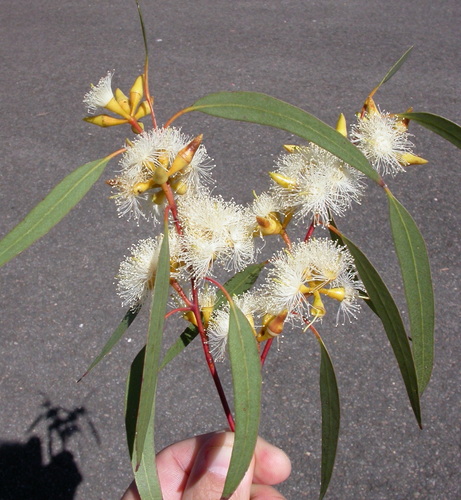
Dwyer's Red Gum
Eucalyptus dwyeri
A resilient survivor of Australia's rocky ridges, Dwyer's Red Gum dazzles with its smooth white bark and nectar-rich blossoms. It is a cornerstone of the inland bush, providing a vital sanctuary for nectar-loving birds and hardy pollinators.
Quick Identification
Size
Small tree or mallee reaching 6–15 metres (20–50 feet) in height
Colors
Smooth white, cream, or pale grey bark; dull green adult leaves; creamy-white blossoms
Key Features
- Smooth white or cream bark shedding in irregular flakes
- Lance-shaped adult leaves 7–15 cm long
- Flower buds occurring in distinct groups of seven
- Small conical or bell-shaped fruit 5–9 mm wide
When You’ll See Them
Geographic range
Where Does the Dwyer's Red Gum Live?
Dwyer's Red Gum is a native specialist of Eastern Australia, primarily concentrated along the inland slopes and tablelands of the Great Dividing Range. Its core range extends through New South Wales, reaching north into southern Queensland and south into parts of northern Victoria. It is typically found in rugged, well-drained terrain, often dominating sandstone or granite outcrops where other eucalyptus species struggle to take root.
Basemap © OpenStreetMap contributors
Behavior
Dwyer's Red Gum is a hardy and adaptable Australian native, often taking the form of a 'mallee'—a multi-stemmed growth habit that arises from a large underground lignotuber. This structure is a survival mechanism, allowing the tree to regenerate quickly following bushfires or severe droughts. In more sheltered environments with better soil, it may grow as a single-trunked small tree with a graceful, spreading canopy.
Though the tree itself is stationary, its 'behavior' is defined by its seasonal cycles. From late winter through early summer, it undergoes a massive flowering event. These creamy-white blossoms are high in nectar, transforming the tree into a social hub for the local ecosystem. It doesn't just sit there; it actively supports a wide array of life, providing nesting hollows for birds and essential food for pollinators.
EverydayEarth exclusive
Camera Tips
To capture the true essence of Dwyer's Red Gum, position your camera to focus on the flowering canopy rather than just the trunk. If you have a tall tripod or a safe way to mount a camera on a nearby structure, aim it at a cluster of buds just before they open. Using a time-lapse setting (one photo every 15–30 minutes) can beautifully document the transition from bud to full blossom over several days.
Because this tree is a magnet for fast-moving honeyeaters and lorikeets, you'll need a camera with a high trigger speed. Set your device to 'burst mode' or 'rapid fire' to ensure you catch the birds in mid-feed. Since these visitors are most active in the early morning light, ensure your camera's exposure settings are adjusted for the bright, direct Australian sun to avoid washing out the white bark and pale flowers.
Don't ignore the trunk! The smooth, mottled bark of the Dwyer's Red Gum provides excellent textures for macro photography. If you are using a trail camera for wildlife, place it 3–5 feet off the ground facing the trunk to capture reptiles like tree dragons or geckos that often scramble up the smooth surface. During the shedding season, the peeling bark creates dramatic shapes that look fantastic in high-contrast black and white settings.
If your goal is to see who visits the tree at night, such as sugar gliders or possums attracted to the nectar, use a 'no-glow' infrared flash. Standard white flashes can startle nocturnal mammals and wash out the reflective white bark. Aim the camera at a fork in the branches where mammals are likely to pause and groom or feed on the blossoms.
Similar Species
Species that look similar or are commonly confused with Dwyer's Red Gum.
Frequently Asked Questions
Record Dwyer's Red Gum at your habitat
Connect a camera to start building your own species record — AI identifies every visitor automatically.