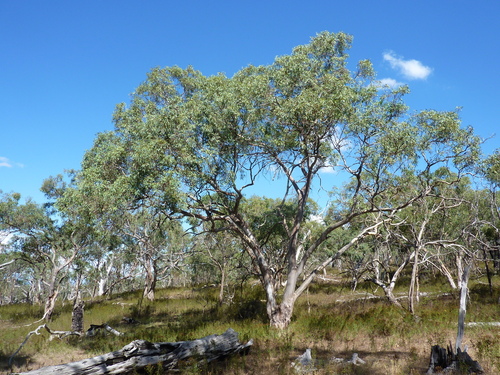
Blakely's red gum
Eucalyptus blakelyi
A cornerstone of the Australian bush, Blakely's red gum is a majestic evergreen known for its smooth, mottled bark and its vital role in supporting honey-loving birds and arboreal mammals.
Quick Identification
Size
A medium-sized tree typically reaching 10–25 metres (33–82 feet) in height with a trunk diameter up to 1 metre.
Colors
Bark is mottled with patches of white, grey, and cream; leaves are a dull bluish-green on both sides.
Key Features
- Smooth bark that sheds in large plates or flakes
- Dull bluish-green, lance-shaped adult leaves
- Flower buds typically arranged in groups of seven
- Cup-shaped to hemispherical fruit with protruding valves
When You’ll See Them
Geographic range
Where Does the Blakely's red gum Live?
Native to the eastern mainland of Australia, Blakely's red gum is a defining feature of the inland slopes and tablelands of New South Wales and the Australian Capital Territory. Its range extends north into the southern regions of Queensland and southward into the northern reaches of Victoria. It thrives in the temperate zones along the Great Dividing Range, often forming the dominant canopy in grassy woodland communities where the climate is characterized by cool winters and warm summers.
Basemap © OpenStreetMap contributors
Behavior
Blakely's red gum is a foundational species in Australian grassy woodland ecosystems. Unlike animals, its 'behavior' is defined by its seasonal growth cycles and its interactions with local fauna. It is a prolific flowerer, typically bursting into bloom between October and January. During these months, the tree becomes a bustling hub of activity, producing copious amounts of nectar that attract a wide array of honeyeaters, lorikeets, and native bees. It plays a critical role in the 'mating' of the landscape by providing the necessary energy for migrating birds moving along the Great Dividing Range.
This species is also known for its resilience and long-term survival strategy. As it matures, it naturally sheds limbs and develops hollows, which are essential nesting sites for parrots, owls, and arboreal mammals like gliders and brushtail possums. In suburban environments, it acts as a vital bridge for wildlife, though it is susceptible to 'dieback' caused by over-grazing by insects like psyllids, often linked to imbalances in the local bird population that would otherwise keep these pests in check.
EverydayEarth exclusive
Camera Tips
Capturing the life around a Blakely's red gum requires a dual-angle strategy. To document the high-energy nectar feeders like the Swift Parrot or various Honeyeaters, mount your camera on a high-reaching pole or a neighboring structure, angled toward the outer canopy during the spring flowering season. Use a fast shutter speed or high-frame-rate video setting, as these birds move rapidly between blossoms. Early morning light (6:00 AM to 9:00 AM) provides the best illumination for the bluish-green foliage and white flowers.
For arboreal mammals like the Sugar Glider or Common Brushtail Possum, place your camera directly on the main trunk of the tree at a height of 3 to 5 metres (10–16 feet), facing downward toward a specific fork or hollow entrance. Infrared triggers are essential here, as these creatures are strictly nocturnal. If you are looking to capture the tree’s unique 'mottled' bark textures, set your camera to take high-resolution stills during midday when the sun is directly overhead, which highlights the contrast between the white and grey patches.
If your goal is to monitor the overall health of your backyard ecosystem, consider a time-lapse setting. By taking one photo every hour, you can document the tree’s seasonal changes—from the shedding of bark in large plates to the dramatic explosion of white flowers. Ensure your camera is secured with a heavy-duty strap, as the smooth bark of the Blakely's red gum offers little friction, and the camera may slip during heavy winds or rain if not tightened properly.
Similar Species
Species that look similar or are commonly confused with Blakely's red gum.
Frequently Asked Questions
Record Blakely's red gum at your habitat
Connect a camera to start building your own species record — AI identifies every visitor automatically.