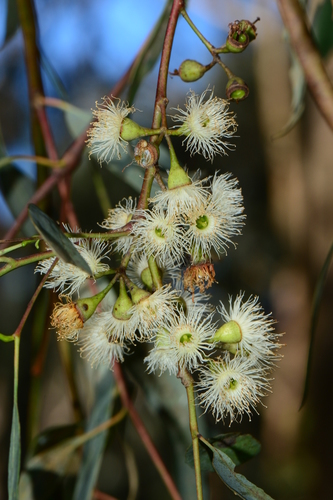
Yellow Box
Eucalyptus melliodora
Known as Australia's premier honey tree, the Yellow Box is a majestic evergreen that provides a vital sanctuary for nectar-loving birds and arboreal mammals.
Quick Identification
Size
Typically reaches heights of 15–30 metres (50–100 feet) with a canopy spread of 10–20 metres (33–66 feet).
Colors
Lower bark is yellowish-brown and fibrous; upper branches are smooth grey, white, or yellowish. Foliage is a muted grey-green.
Key Features
- Distinctive yellowish, flaky bark on the lower trunk
- Honey-scented white or cream flowers occurring in clusters of seven
- Grey-green lance-shaped leaves with visible veins
- Small hemispherical or pear-shaped woody fruit (gumnuts)
When You’ll See Them
Geographic range
Where Does the Yellow Box Live?
The Yellow Box is native to the Australian continent, primarily occupying the south-eastern mainland. Its core range extends along the western slopes and tablelands of the Great Dividing Range, stretching from the rugged highlands of Victoria through the heart of New South Wales and up into the southern reaches of Queensland. It is a resilient survivor in the temperate and subtropical interior, often found on fertile, well-drained soils where it stands as a sentinel of the classic Australian 'bush' landscape.
Basemap © OpenStreetMap contributors
Behavior
The Yellow Box is a slow-growing, long-lived hardwood that acts as a cornerstone of the Australian grassy woodland ecosystem. Unlike many animals that exhibit social behaviors, this tree's 'behavior' is best observed through its phenology and ecological relationships. It is famous for its irregular but prolific flowering cycle, which can happen at any time of year but peaks in late spring and summer. During these windows, the tree becomes a hub of activity, producing massive amounts of nectar that support high densities of pollinators.
Ecologically, the Yellow Box is a 'habitat tree.' As it ages—often living for several centuries—it naturally develops hollows in its trunk and limbs. These hollows are essential real estate for Australian wildlife, providing nesting sites for parrots, owls, and arboreal mammals like the Sugar Glider. In a backyard setting, a mature Yellow Box serves as a multi-story apartment complex, where different species occupy various levels of the canopy and trunk throughout the day and night.
EverydayEarth exclusive
Camera Tips
When using an AI camera to monitor a Yellow Box, the tree itself acts as the 'stage' for wildlife. For the best results, place your camera approximately 2 to 3 metres up the trunk, angled slightly downward toward a large horizontal limb. This is the 'highway' for arboreal mammals like Brush-tail Possums and Squirrel Gliders. If your camera is at ground level, aim it at the base of the trunk where the rough, yellow bark meets the soil to catch goannas or echidnas foraging for insects in the debris.
If you are targeting birds, position your camera with a clear view of the outer canopy during the flowering season (late spring). Yellow Box flowers are a magnet for honeyeaters and lorikeets. Because these birds move quickly, use a high shutter speed or a 'burst' photo mode. Ensure the sun is behind the camera to highlight the subtle yellow and grey textures of the bark, which provides a beautiful, natural backdrop for high-definition captures.
For nocturnal activity, ensure your infrared (IR) flash is set to medium intensity. The reflective nature of the smooth upper bark can sometimes cause 'white-out' on photos if the flash is too strong. If the tree has a visible hollow, focus your camera on that opening; this is a high-traffic area where you can capture incredible footage of owlet-nightjars or possums emerging at dusk. Seasonal monitoring is key, as the tree will be quiet for months then suddenly explode with birdlife once the honey-scented buds open.
Similar Species
Species that look similar or are commonly confused with Yellow Box.
Frequently Asked Questions
Record Yellow Box at your habitat
Connect a camera to start building your own species record — AI identifies every visitor automatically.