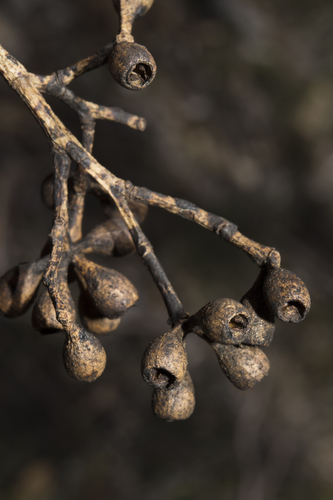
grey box
Eucalyptus moluccana
A stalwart of the Australian landscape, the grey box is more than just a tree; it's a bustling high-rise apartment for native wildlife. From its distinctive 'gum-top' branches to its nectar-rich blossoms, it is a centerpiece of biodiversity in eastern woodlands.
Quick Identification
Size
Height of 15–30 meters (50–100 feet) with a trunk diameter up to 1 meter (3.3 feet)
Colors
Grey to grey-brown fibrous bark on the lower trunk; smooth, whitish, or pale grey bark on upper branches; dull green to grey-green foliage
Key Features
- Persistent, box-like fibrous bark on the lower half of the trunk
- Smooth 'gum-topped' upper branches that shed in ribbons
- Lance-shaped adult leaves with fine, parallel veins
- White flowers arranged in clusters of seven buds
When You’ll See Them
Geographic range
Where Does the grey box Live?
Native to the continent of Australia, the grey box is primarily found in a broad band along the eastern coast. Its core range spans from the northern regions of Queensland, moving south through the central coast, and extending into the western slopes and plains of New South Wales. While it stays relatively close to the coast, it is well-adapted to the drier conditions found just behind the Great Dividing Range.
Basemap © OpenStreetMap contributors
Behavior
The grey box is a long-lived, hardy tree that serves as a keystone species in the grassy woodlands of Eastern Australia. Unlike animals, its 'behavior' is defined by its resilience to drought and its slow, steady growth in heavy clay soils. It often forms open woodland structures where the canopy allows enough light for a diverse understory of native grasses and wildflowers to thrive.
Ecologically, the grey box is a vital provider. As the tree matures, it naturally develops hollows in its trunk and limbs, which become essential real estate for nesting birds, microbats, and arboreal marsupials. It is also a prolific producer of nectar and pollen, making it a critical food source for pollinators during its flowering season in late summer and autumn.
EverydayEarth exclusive
Camera Tips
To capture the incredible diversity of wildlife that visits a grey box, mount your AI-powered camera approximately 1.5 to 2.5 meters (5 to 8 feet) up the trunk. Angle the lens slightly upward to monitor the 'v-junctions' of major branches, as these are primary travel routes for arboreal mammals like the Common Brushtail Possum or Squirrel Glider. If your camera has a wide-angle lens, this is the perfect spot to capture birds arriving for nectar.
During the flowering season (February to June), the grey box becomes a hive of activity. For best results, place a second camera on a tripod or fence post about 3 to 5 meters away from the trunk, facing the lower canopy. This perspective allows you to see honeyeaters and lorikeets during the day, and flying foxes at night. Use a 'high sensitivity' PIR setting, as the movement of birds among the leaves can be subtle and fast.
Because the bark on the lower trunk of a grey box is rough and fibrous, use a sturdy mounting strap or a screw-in tree mount to ensure the camera doesn't shift. If you are targeting reptiles like Lace Monitors, which frequently climb these trees to raid nests, position the camera lower down (about 0.5 meters from the ground) and face it directly at the trunk to capture them as they begin their ascent.
Similar Species
Species that look similar or are commonly confused with grey box.
Frequently Asked Questions
Record grey box at your habitat
Connect a camera to start building your own species record — AI identifies every visitor automatically.