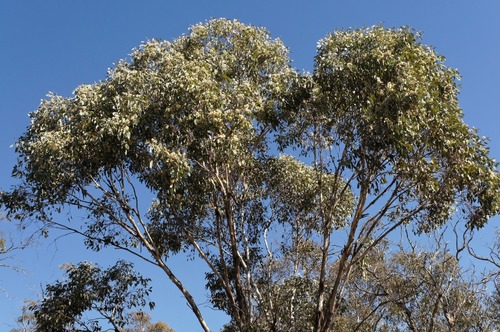
white box
Eucalyptus albens
The white box is the majestic anchor of Australia's western slopes, providing a nectar-filled pantry and hollow-filled homes for a vast array of unique wildlife.
Quick Identification
Size
Typically 15-25 metres (50-80 feet) tall, with a trunk diameter up to 1.5 metres (5 feet).
Colors
Dull grey-green foliage; base has rough grey fibrous bark; upper branches are smooth and creamy-white.
Key Features
- Rough, fibrous 'box' bark on the lower trunk
- Smooth, white or pale grey bark on upper branches
- Dull, bluish-grey or grey-green lance-shaped leaves
- Spindle-shaped flower buds in clusters of seven
When You’ll See Them
Geographic range
Where Does the white box Live?
Native to the Australian continent, the white box is a characteristic feature of the inland slopes and plains of southeastern Australia. Its primary range spans the western foothills of the Great Dividing Range across New South Wales, extending north into southern Queensland and south into Northern Victoria. It thrives in the transitional zone between the humid coast and the arid interior, though its native woodlands are now considered a highly significant and protected ecological community.
Basemap © OpenStreetMap contributors
Behavior
The white box is a foundational pillar of the Australian grassy woodland ecosystem. Unlike mobile wildlife, its 'behavior' is defined by its seasonal cycles and its role as a massive biological hub. It is a slow-growing hardwood that can live for centuries, eventually developing the deep hollows that are essential for the survival of many Australian bird and mammal species.
This species is famous for its 'pulse' flowering events. Every few years, a white box stand will produce a massive amount of nectar-rich white flowers, a phenomenon that can be smelled from a distance and triggers a massive influx of nomadic nectar-feeders. For humans, it is one of the most valued trees for high-quality honey production, as its nectar produces a light, buttery honey that is prized by apiarists.
EverydayEarth exclusive
Camera Tips
To capture the secret life of a white box tree, don't just point your camera at the ground. This tree is a vertical highway. Mount your camera about 2-3 metres up the main trunk, angled slightly downward to capture 'scansorial' (climbing) species like the Brush-tailed Phascogale or Squirrel Glider that use the rough bark for grip.
During the flowering season from August to February, the canopy is where the action is. If you have a branch that reaches low, or a nearby structure, position your camera to face the flower clusters. Use a fast shutter speed or high-frame-rate video to capture the rapid movements of nectar-feeding honeyeaters and the rare Swift Parrot, which specifically seeks out these blossoms during its migration.
Look for 'hollows'—small holes in the trunk or limbs where branches have fallen off. These are prime real estate. Setting a camera to watch a hollow can reveal a rotating cast of residents, from nesting Galahs and Crimson Rosellas during the day to Sugar Gliders at night. Because the upper bark of the white box is highly reflective and white, adjust your camera's night-vision settings to 'Low' or 'Medium' IR intensity to prevent the image from being blown out by the flash bouncing off the pale wood.
Finally, the base of the tree is a great spot for leaf-litter foragers. Fallen bark from a white box creates a micro-habitat for skinks and insects, which in turn attract echidnas. Placing a camera near the base of an older tree with lots of 'shaggy' bark at the bottom will often capture these ground-dwellers as they probe for food.
Similar Species
Species that look similar or are commonly confused with white box.
Yellow Box
Yellow box has more yellowish-brown inner bark and much smaller, more delicate flowers and fruit.
Grey Box
Grey box has smaller fruit and the rough, 'box' bark usually extends much further up into the branches.
Blakely's Red Gum
Often grows alongside white box but has almost entirely smooth bark and different, horn-shaped flower buds.
Frequently Asked Questions
Record white box at your habitat
Connect a camera to start building your own species record — AI identifies every visitor automatically.