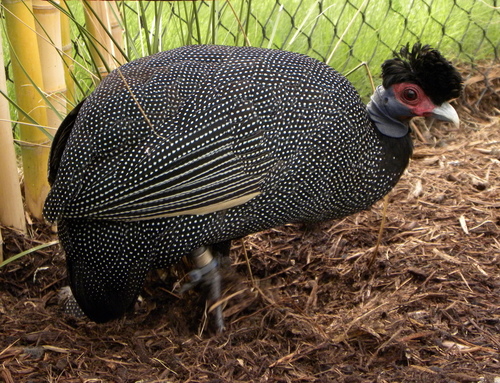
Eastern Crested Guineafowl
Guttera pucherani
With its wild 'mop-top' of curly black feathers and striking blue face, the Eastern Crested Guineafowl is the punk-rocker of the African forest. Far more elusive than its helmeted cousins, this bird is a prize for any backyard or trail camera enthusiast in East Africa.
Quick Identification
Size
45-50 cm (18-20 in) in length; weight between 1 and 1.5 kg (2.2-3.3 lbs)
Colors
Uniformly black plumage covered in small, crisp white spots; bare blue skin on the face and neck, with dark red eyes
Key Features
- Prominent 'mop' of curly black feathers on the crown
- Bare blue-grey skin on head and neck
- Black body with fine white spotting
- Plump, chicken-like silhouette with a short tail
When You’ll See Them
Geographic range
Where Does the Eastern Crested Guineafowl Live?
Native to the African continent, the Eastern Crested Guineafowl is primarily found throughout East and Southeast Africa. Its core range extends from the coastal forests of Somalia and Kenya, southward through Tanzania and Mozambique, and into the forested regions of Zimbabwe and South Africa. This species is a specialist of forest-edge habitats, thriving where dense canopy meets more open foraging grounds.
Basemap © OpenStreetMap contributors
Behavior
The Eastern Crested Guineafowl is a highly social and gregarious bird, typically found in flocks of 10 to 30 individuals known as 'confusions.' Unlike their more famous cousins, the Helmeted Guineafowl, these birds are quite shy and prefer the security of dense forest cover. They spend the majority of their daylight hours on the ground, methodically scratching through leaf litter in search of food. Their social structure is tight-knit, and they communicate constantly with a variety of rhythmic, metallic clinking sounds that help the group stay together in thick undergrowth.
As evening approaches, the flock becomes more vocal before flying up into the mid-canopy of large trees to roost for the night, safe from terrestrial predators. In suburban or edge environments, they can become somewhat accustomed to humans but will quickly run—rather than fly—into thickets if approached too closely. Their movement is characterized by a quick, nervous gait, always appearing to be in a hurry as they navigate the forest floor.
EverydayEarth exclusive
Camera Tips
To capture the Eastern Crested Guineafowl, place your camera low—ideally 12 to 18 inches off the ground. These birds are strictly ground-foragers and rarely take flight unless they are moving to their nighttime roost, so a low-profile mounting point ensures you capture the intricate detail of their spotting and that signature 'mop-top' crest. If you are setting up on a slope, angle the camera slightly upward to account for their height as they peck at the ground.
Focus your efforts on transition zones where dense garden vegetation or forest meets an open clearing or lawn. They are particularly drawn to water sources during the dry season, so placing a camera near a ground-level birdbath or a natural puddle is highly effective. If it is legal and ethical in your area, scattering a handful of cracked corn or wild birdseed in the leaf litter can entice a flock to stay in the camera's field of view for much longer than they otherwise would.
Set your camera to a fast trigger speed and use 'Burst Mode' or a 20-second video clip setting. Guineafowl move with quick, jerky motions and travel in single-file lines or loose clusters; a single photo will often only catch the leader of the flock, while a video or burst will capture the entire social group. They are most active in the 'golden hours' shortly after sunrise and just before dusk when the light is soft, so ensure your camera is positioned to avoid direct lens flare during these times.
Finally, look for signs of their presence before choosing a spot. They leave behind distinctive 'scuffs' in the dirt where they have been scratching for insects, as well as small, white-spotted feathers. If you find a communal dusting bowl—a patch of loose, dry dirt where they bathe—it is an ideal location for a camera, as the birds will often spend several minutes there preening and socializing.
Similar Species
Species that look similar or are commonly confused with Eastern Crested Guineafowl.
Frequently Asked Questions
Record Eastern Crested Guineafowl at your habitat
Connect a camera to start building your own species record — AI identifies every visitor automatically.