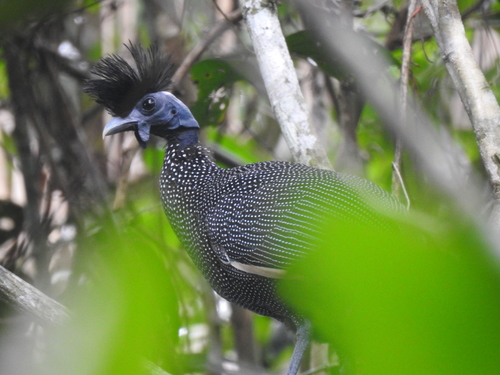
Plumed Guineafowl
Guttera plumifera
Meet the punk-rocker of the African rainforest. With its striking upright crest and electric-blue face, the Plumed Guineafowl is a master of the shadows and a crown jewel for any trail camera enthusiast.
Quick Identification
Size
Length of 45-50 cm (18-20 in); Weight approximately 750-1000g (1.6-2.2 lbs)
Colors
Dark blackish-brown body covered in fine white spots; bare dull grey-blue skin on the head and neck; black crest
Key Features
- Straight, upright brush-like black crest
- Long, thin wattles on either side of the bill
- Bare grey-blue facial skin
- Stocky, chicken-like body with white-spotted plumage
When You’ll See Them
Behavior
The Plumed Guineafowl is a shy and secretive resident of the deep forest. Unlike the more famous Helmeted Guineafowl seen on open savannas, this species prefers the dim light of the primary rainforest understory. They are highly social within their own circles, typically moving in small coveys of 10 to 40 birds, maintaining contact with soft, low-pitched calls that help them stay together in dense vegetation.
These birds are primarily terrestrial and spend the majority of their day scratching through leaf litter in search of food. When threatened, they are much more likely to run rapidly into thick cover than to take flight. At night, they retreat to the safety of the middle canopy, roosting in trees to avoid ground predators like leopards or golden cats.
EverydayEarth exclusive
Camera Tips
To capture the Plumed Guineafowl, camera placement is everything. Because they are strictly ground-dwellers during the day, your camera should be mounted very low, roughly 12 to 18 inches off the forest floor. Angle the lens slightly upward if you are on a slope, but on level ground, a straight horizontal shot works best to capture the intricate details of their 'punk-rock' crest and facial wattles.
Lighting is your biggest challenge in the humid primary forest. The canopy often blocks significant sunlight, making the forest floor quite dark even at noon. Use a camera with a high-quality infrared (IR) flash to ensure clear images without spooking the birds. If your camera allows for 'Hybrid Mode,' capturing a 10-second video clip following a still image can reveal their fascinating social scratching behaviors and vocalizations.
Target 'micro-habitats' such as the edges of small forest clearings, dried stream beds, or areas beneath fruiting trees where fallen figs or berries might accumulate. You don't necessarily need bait; these birds follow predictable paths through the undergrowth. Look for 'scratch zones' where the leaf litter has been disturbed—this is a surefire sign that a covey has recently passed through and will likely return.
Set your trigger speed to the fastest possible setting. While they move slowly when foraging, they can be surprisingly quick when crossing open patches of the trail. A trigger speed of 0.3 seconds or faster will ensure you don't just end up with a photo of a disappearing tail feather.
Similar Species
Species that look similar or are commonly confused with Plumed Guineafowl.
Frequently Asked Questions
Record Plumed Guineafowl at your habitat
Connect a camera to start building your own species record — AI identifies every visitor automatically.