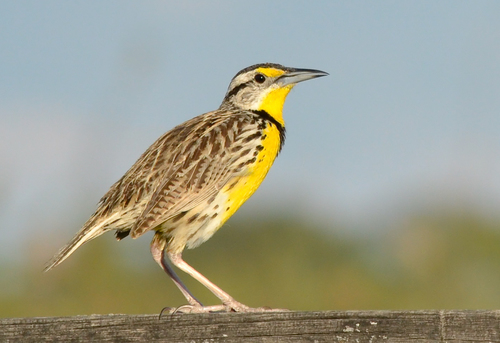
Eastern Meadowlark
Sturnella magna
With its brilliant yellow breast and melodic, flute-like song, the Eastern Meadowlark is the golden crown of the American grasslands. Often found perching on fence posts, these iconic meadow-dwellers bring the spirit of the prairie to any open backyard.
Quick Identification
Size
Length: 19–28 cm (7.5–11 in); Wingspan: 33–40 cm (13–15.7 in); Weight: 76–150 g (2.7–5.3 oz)
Colors
Bright yellow throat and belly with a bold black 'V' on the chest; brown and black streaked upperparts; white outer tail feathers prominent in flight.
Key Features
- Distinctive black V-shaped collar on a bright yellow breast
- Pointed, spear-like bill for ground probing
- White outer tail feathers visible during short, jerky flights
- Streaked brown back that provides camouflage in tall grass
When You’ll See Them
Geographic range
Where Does the Eastern Meadowlark Live?
Native to the Americas, the Eastern Meadowlark occupies a massive footprint stretching from the eastern half of the United States and southeastern Canada down through Mexico and Central America into northern South America. Its heartland is the Great Plains and the rolling agricultural pastures of the eastern U.S., where it thrives in wide-open landscapes far from dense forests. While southern populations are generally year-round residents, those breeding in the northernmost reaches of the U.S. and Canada migrate southward to find snow-free foraging grounds during the winter.
Basemap © OpenStreetMap contributors
Behavior
The Eastern Meadowlark is a quintessential bird of the open fields, known for its habit of perching on fence posts, utility lines, or the tops of tall weeds to announce its presence. During the breeding season, males are highly territorial, delivering a sweet, slurring whistle that is often described as 'spring-is-here.' They are shy around humans and will usually flush into a low, flapping-and-gliding flight if approached, showing off their white outer tail feathers as they retreat.
On the ground, these birds are diligent foragers. Unlike many birds that hop, meadowlarks walk or run through the grass. They use a unique foraging technique called 'gaping,' where they insert their closed bill into the soil or a clump of grass and then force it open to reveal hidden insects or seeds. While they are social in the winter, forming small flocks called 'exaltations,' they remain primarily ground-dwelling birds that rely on their cryptic brown backs to hide from predators.
EverydayEarth exclusive
Camera Tips
To capture the Eastern Meadowlark on camera, location is everything. These birds are almost exclusively ground-dwellers and low-perchers. If you have a large backyard or acreage bordering a field, place your camera about 12 to 18 inches off the ground. Aiming the lens at a prominent, solitary 'singing post'—like a wooden fence stake or a sturdy tall weed—is your best bet for capturing the male's iconic vocal displays. Use a side-angle to the sun to highlight the brilliant yellow of the breast without washing out the black 'V' mark.
Because meadowlarks are wary, use a camera with a fast trigger speed (0.3 seconds or less) and a high-quality PIR sensor. They often land abruptly and then freeze, so a camera set to take a 'burst' of 3-5 photos or a 15-second video will help you catch the moment they transition from flight to their characteristic walking gait. If you are using a bait-style setup, avoid traditional hanging feeders. Instead, create a flat, ground-level foraging station with cracked corn or hulled sunflower seeds, but keep it in a spot where the grass is kept short so the bird feels safe from stalking predators like cats.
During the spring and summer, meadowlarks are most active in the very early morning, often beginning their songs at first light. Ensure your camera's ISO settings are capable of handling low-light conditions to get clear shots during these peak dawn hours. In the winter, look for 'seep' areas where the ground doesn't freeze or spots where hay has been recently turned over, as these birds will congregate there to find dormant insects. Finally, since they are easily spooked, use a camouflage wrap on your camera or hide it within a brush pile to minimize the 'foreign object' look that might deter them.
Similar Species
Species that look similar or are commonly confused with Eastern Meadowlark.
Frequently Asked Questions
Record Eastern Meadowlark at your habitat
Connect a camera to start building your own species record — AI identifies every visitor automatically.