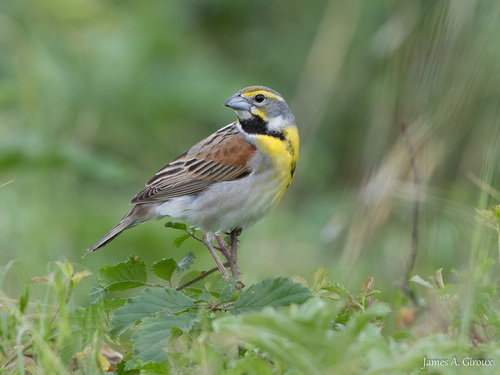
Dickcissel
Spiza americana
Often called the 'miniature meadowlark,' the Dickcissel is a vibrant icon of the American grasslands. With its bright yellow breast and rhythmic, buzzy song, this hardy migrant brings the spirit of the prairie to life.
Quick Identification
Size
Length: 5.5-6.3 in (14-16 cm); Wingspan: 9.8-10.2 in (25-26 cm); Weight: 0.8-1.1 oz (23-32 g)
Colors
Males have yellow breasts with a black V-shaped bib, grey heads, and chestnut shoulder patches; females are duller brown with subtle yellow wash and streaking.
Key Features
- Distinctive black V-shaped bib on a yellow chest (males)
- Rusty chestnut-colored patches on the shoulders
- Heavy, conical pale grey bill
- Pale yellow stripe above the eye (supercilium)
- Sharp, buzzy 'dick-ciss-ciss-cissel' song
When You’ll See Them
Geographic range
Where Does the Dickcissel Live?
Native to the Western Hemisphere, the Dickcissel is a long-distance traveler that primarily breeds in the 'breadbasket' of North America. Its core breeding range spans the Great Plains and Midwestern United States, reaching from northern Texas up into southern Canada. As autumn approaches, they embark on a massive migration through Mexico and Central America to reach their wintering strongholds in the tropical grasslands and agricultural regions of northern South America, particularly in Venezuela and Colombia.
Basemap © OpenStreetMap contributors
Behavior
Dickcissels are the quintessential soundtrack of the American prairie. During the breeding season, males are conspicuous and persistent singers, often perching atop fence posts, tall weed stalks, or shrubs to defend their territory with their namesake buzzy call. They are somewhat nomadic in their breeding habits, with populations shifting year-to-year based on rainfall and grass height, making them a delightful surprise for birdwatchers when they suddenly appear in a new field.
While they are solitary or found in pairs during the nesting season, Dickcissels undergo a dramatic social shift during migration and winter. They form massive, swirling flocks that can number in the tens of thousands. In their wintering grounds in South America, these huge groups move across agricultural landscapes in search of grain, acting much more like starlings or blackbirds than the solitary singers they were in the North.
EverydayEarth exclusive
Camera Tips
To capture a Dickcissel on your backyard or trail camera, focus on their preferred 'stages.' Males love to sing from the highest available point in an open field. If you have a fence line or a tall, sturdy wildflower stalk like Mullein or Cup Plant, aim your camera at the top third of these structures. A side-on angle about 4 to 5 feet off the ground is ideal to catch the detail of the male's black bib and yellow chest against the sky or a green field background.
While they aren't common visitors to traditional hopper feeders, they are highly attracted to water, especially during the heat of mid-summer. Placing a camera near a ground-level bird bath or a shallow solar fountain can result in excellent close-up footage as they stop to drink and bathe. Use a fast shutter speed or high-frame-rate video setting, as their movements are quick and 'buzzy.'
For those in suburban areas bordering fields, scattering white proso millet or sunflower hearts on the ground near cover can entice migrating Dickcissels to stay long enough for a photo. Set your camera to 'Burst Mode' to ensure you catch the moment they look up from feeding, which is when their facial markings are most visible. During the peak breeding months of June and July, the first three hours after sunrise provide the best lighting and the highest activity levels.
Similar Species
Species that look similar or are commonly confused with Dickcissel.
Eastern Meadowlark
Much larger (robin-sized) with a long, thin pointed bill and white outer tail feathers.
House Sparrow
Males have a black bib but lack the bright yellow breast and chestnut shoulder patches of the Dickcissel.
Western Meadowlark
Larger with a different, flute-like song and yellow extending onto the throat and malar area.
Frequently Asked Questions
Record Dickcissel at your habitat
Connect a camera to start building your own species record — AI identifies every visitor automatically.