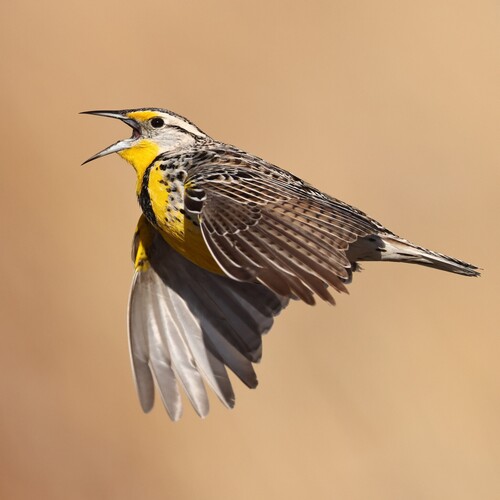
Western Meadowlark
Sturnella neglecta
The Western Meadowlark is a vibrant symbol of the open prairie, easily recognized by its brilliant yellow chest and iconic black collar. Its flute-like song is the soundtrack of the American West, bringing life to grasslands and fields.
Quick Identification
Size
Length: 7.9–10.2 in (20–26 cm); Wingspan: 16 in (41 cm); Weight: 3.1–4.1 oz (89–115 g)
Colors
Bright yellow throat and belly, distinct black 'V' on the breast, brown and white streaked upperparts, and white outer tail feathers.
Key Features
- Brilliant yellow chest with a bold black 'V' collar
- Long, pointed bill and flat-headed profile
- White outer tail feathers visible in flight
- Brown-and-black mottled back for grassland camouflage
When You’ll See Them
Sightings on EverydayEarth
May 19, 2026
A Western Meadowlark is perched on a wooden beam over the water. It remains alert, looking around the pond while the Mission Mountains are visible in the background under an overcast sky.
Behavior
The Western Meadowlark is the quintessential bird of the American West, known for its rich, flute-like song that carries across open prairies and agricultural fields. Unlike many other songbirds, meadowlarks are ground-dwellers. They spend the majority of their time walking or running through low vegetation rather than hopping. They use a foraging technique called 'gaping,' where they insert their bill into the soil or a clump of grass and then force it open to reveal hidden insects or seeds.
During the breeding season, males are highly conspicuous as they sing from prominent perches like fence posts, shrubs, or utility lines to defend their territories. They are sensitive to human disturbance during nesting, as they build intricate grass-domed nests directly on the ground. In the winter, they often lose their territorial edge and gather in small, loose flocks to forage in fallow fields and pastures, moving south only if heavy snow covers their food supply.
EverydayEarth exclusive
Camera Tips
To successfully capture a Western Meadowlark on your AI camera, the most critical factor is placement height. Since these birds are ground-oriented, your camera should be mounted no higher than 2 to 3 feet off the ground. If you have a fence line on your property, this is your best asset. Meadowlarks love to use fence posts as singing perches. Mounting a camera on a post facing another post roughly 10 feet away can yield stunning 'trophy' shots of a male with its chest puffed out and beak open in song.
Because they are shy of human structures, place your camera in an open, grassy area rather than right against your house. If you want to draw them into frame, focus on a patch of bare earth or short grass. While they don't typically visit traditional hanging bird feeders, you can successfully lure them using a 'ground station.' Scatter cracked corn, hulled sunflower seeds, or mealworms on a flat rock or a patch of cleared ground. This mimics their natural foraging behavior and encourages them to linger in front of the lens.
Lighting is another key consideration for this species. Their yellow breast is highly reflective and can easily 'blow out' in harsh midday sun, losing all detail. Position your camera to face north or south so the morning and evening light hits the bird from the side. This soft 'golden hour' light will emphasize the texture of their feathers and the depth of the black 'V' on their chest. If your camera has adjustable trigger settings, set it to a short delay or high-sensitivity 'burst' mode, as meadowlarks move with quick, jerky head motions that are easy to miss with a slow trigger.
Similar Species
Species that look similar or are commonly confused with Western Meadowlark.
Eastern Meadowlark
Almost identical but has a simpler whistled song and the yellow on its throat does not extend as far onto the malar (cheek) area.
Dickcissel
Much smaller with a thicker, finch-like bill; while it has a yellow chest and black V, it lacks the long bill and white outer tail feathers of the meadowlark.
Frequently Asked Questions
Record Western Meadowlark at your habitat
Connect a camera to start building your own species record — AI identifies every visitor automatically.