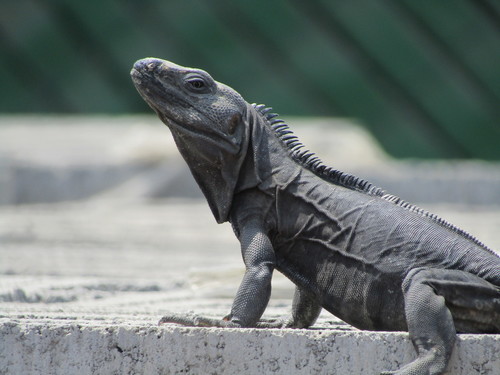
Eastern Mexican Spiny-Tailed Iguana
Ctenosaura acanthura
With its armored tail and prehistoric silhouette, the Eastern Mexican Spiny-Tailed Iguana is a charismatic relic of the tropical lowlands. A master of the sun-drenched stone, this agile lizard is as comfortable scaling ancient ruins as it is patrolling a backyard garden.
Quick Identification
Size
Total length of 1 to 1.4 meters (3.3 to 4.6 feet); weight typically 1 to 2 kg (2.2 to 4.4 lbs).
Colors
Adults are mostly charcoal gray to jet black with light gray or cream mottling; juveniles are vibrant emerald green with dark vertical bands.
Key Features
- Whorls of sharp, enlarged spines covering the entire length of the tail
- A prominent crest of spines along the back, largest at the neck
- Robust, muscular limbs designed for high-speed sprinting and climbing
When You’ll See Them
Geographic range
Where Does the Eastern Mexican Spiny-Tailed Iguana Live?
This species is native to the North American continent, specifically flourishing along the eastern coastal plains and foothills of Mexico. Its primary range encompasses the states of Tamaulipas and Veracruz, extending southward into the tropical lowlands. While its heartland is eastern Mexico, populations also reach into the extreme western edges of Guatemala, frequently inhabiting the sun-drenched stones of ancient archaeological sites.
Basemap © OpenStreetMap contributors
Behavior
The Eastern Mexican Spiny-Tailed Iguana is a sun-loving diurnal reptile that spends a significant portion of its day thermoregulating. In the morning hours, you will find them perched atop rocks, stone walls, or roofs, soaking up the sun's rays to kickstart their metabolism. While they appear stationary and stoic during these basking sessions, they are incredibly alert; at the first sign of a predator or a perceived threat, they can vanish into a crevice or up a tree with surprising agility and speed.
These lizards are somewhat social but maintain a strict hierarchy. Dominant males are highly territorial, defending the best basking spots and access to females through vigorous head-bobbing and occasional physical skirmishes. In suburban environments, they have adapted well to human presence, often utilizing stone architecture and garden walls as artificial cliff faces. Despite their fierce appearance, they are generally shy and will choose flight over fight unless cornered, where they may use their spiny tails as a defensive whip.
EverydayEarth exclusive
Camera Tips
To successfully capture the Eastern Mexican Spiny-Tailed Iguana on camera, you must focus on 'hot spots'—quite literally. These reptiles are slaves to the sun, so identify flat, south-facing surfaces like stone walls, large rocks, or paved edges where they bask. Because they are ectothermic, standard heat-trigger (PIR) sensors on trail cameras can struggle to detect them if their body temperature matches the ambient environment. To combat this, set your camera to 'Time Lapse' mode with 1-5 minute intervals during the peak sun hours of 10 AM to 3 PM.
Position your camera at a low angle, roughly 12 to 24 inches off the ground, to get an eye-level perspective of their prehistoric features. This angle highlights the impressive dorsal spines and the namesake 'spiny tail.' If you are placing the camera in a garden, look for their favorite food sources; planting hibiscus or maintaining a patch of fruiting plants like papaya can turn a random path into a consistent photo op. Placing a few slices of overripe melon or bright red flowers in the center of the frame can act as a natural lure to keep them in the shot longer.
Be mindful of the lighting. Since these iguanas love direct sunlight, the contrast between the bright animal and dark shadows in rocky crevices can be extreme. Try to position your camera so the sun is behind it, illuminating the subject directly rather than silhouetting it. If your camera has a 'High' sensitivity setting for its sensor, use it, as it will increase the chances of the camera firing when the iguana makes a quick movement from the shade into its basking spot.
Similar Species
Species that look similar or are commonly confused with Eastern Mexican Spiny-Tailed Iguana.
Western Spiny-Tailed Iguana
Found on the Pacific coast of Mexico rather than the Gulf coast; they have slightly different scale patterns on the tail and different color variations.
Green Iguana
Much larger with a smoother, longer tail and a distinctive large circular scale on their cheek; they are more strictly arboreal and prefer being near water.
Frequently Asked Questions
Record Eastern Mexican Spiny-Tailed Iguana at your habitat
Connect a camera to start building your own species record — AI identifies every visitor automatically.