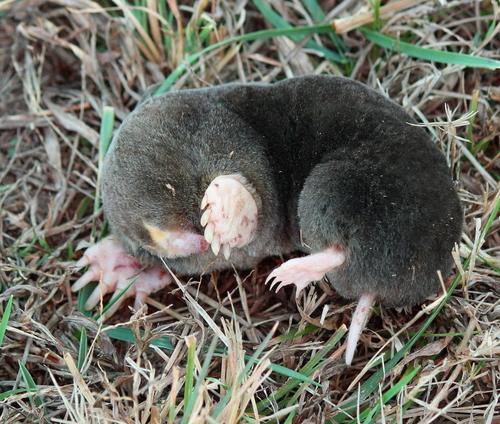
Eastern Mole
Scalopus aquaticus
The Eastern Mole is a subterranean powerhouse, capable of excavating 15 feet of tunnel in a single hour. While rarely seen, their presence is marked by the complex networks of ridges and mounds that reveal a hidden world of activity beneath your feet.
Quick Identification
Size
Length: 11-17 cm (4.3-6.7 inches); Weight: 40-140 grams (1.4-4.9 oz)
Colors
Velvety silvery-gray to brownish-black fur; pinkish-flesh colored snout and feet
Key Features
- Broad, paddle-shaped front feet with large claws
- Pointed, hairless, highly sensitive snout
- Tiny eyes covered by thin skin
- Velvety fur that can be brushed in any direction without resistance
When You’ll See Them
Geographic range
Where Does the Eastern Mole Live?
Native to the North American continent, the Eastern Mole is found across a wide expanse of the eastern United States, stretching from the Atlantic coast to the Great Plains. Its range extends southward into northern Mexico and reaches its northern limit in the southwestern corner of Ontario, Canada. They are most successful in regions where the soil is moist enough to support high worm populations but well-drained enough to prevent tunnel flooding.
Basemap © OpenStreetMap contributors
Behavior
The Eastern Mole is a master of the subterranean world, spending almost its entire life in a complex network of tunnels. They are solitary and highly territorial creatures, rarely interacting with others except during the brief spring mating season. Their physiology is perfectly adapted for life underground: their velvety fur allows them to crawl backward as easily as forward, and their specialized hemoglobin allows them to survive in environments with high carbon dioxide levels.
These mammals are famous for their engineering, creating two distinct types of burrows. Surface tunnels, which appear as raised ridges in lawns and fields, are used for daily foraging. Deeper permanent tunnels, located up to 12 inches below the surface, are used for nesting and escaping extreme temperatures. While homeowners often view their tunneling as a nuisance, Eastern Moles provide an essential service by aerating the soil and consuming massive quantities of lawn pests like Japanese beetle grubs.
EverydayEarth exclusive
Camera Tips
Capturing an Eastern Mole on camera is a unique challenge because they rarely emerge above ground. The most effective strategy is to target 'surface tunnels'—those visible raised ridges in the grass. Find a fresh ridge, gently flatten a small 6-inch section with your foot, and aim your camera at that spot. Use a low-profile stake to mount the camera just 4-6 inches above the ground. When the mole returns to repair the collapsed tunnel, you can capture video of the earth moving or the mole's snout poking through.
Because moles have extremely limited eyesight but are highly sensitive to light and vibrations, a 'No-Glow' (940nm) infrared camera is essential. Standard 'Low-Glow' LEDs may startle them if they surface. Set your camera to its fastest trigger speed or high-frame-rate video mode. They move with surprising speed when they are above ground or repairing a burrow, so a slow trigger will likely result in a blurry tail or a puff of dirt.
Timing is everything with this species. The best time to deploy your camera is immediately following a heavy rain. Rain saturates the soil, driving earthworms toward the surface and forcing the mole to hunt in its shallowest tunnels. In some cases, heavy flooding can even force a mole to surface entirely to find higher ground, which is your best chance for a full-body photo. Avoid using food baits, as moles are motivated by the movement of live prey and won't be attracted to standard backyard lures.
Similar Species
Species that look similar or are commonly confused with Eastern Mole.
Frequently Asked Questions
Record Eastern Mole at your habitat
Connect a camera to start building your own species record — AI identifies every visitor automatically.