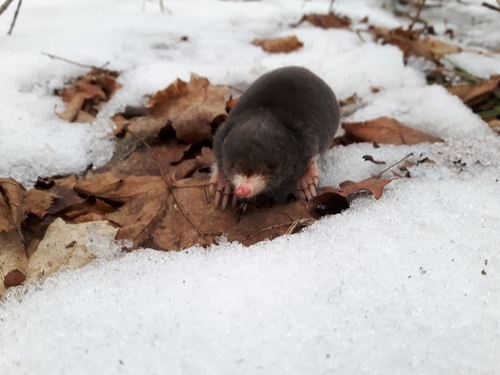
Hairy-tailed Mole
Parascalops breweri
A hidden master of the Appalachian soil, the Hairy-tailed Mole is identified by its uniquely fuzzy tail and industrious digging. This secretive mammal plays a vital role in aerating forest floors and suburban gardens alike.
Quick Identification
Size
Length: 14–17 cm (5.5–6.7 in); Weight: 40–65 g (1.4–2.3 oz)
Colors
Uniformly dark charcoal-grey to black velvety fur; pinkish-grey snout and feet; tail is dark and distinctly hairy.
Key Features
- Short, thick tail covered in dense, stiff hairs
- Large, paddle-shaped front feet with outward-facing claws
- Pointed, fleshy snout without star-like appendages
- Velvety dark grey fur that can be brushed in any direction
When You’ll See Them
Geographic range
Where Does the Hairy-tailed Mole Live?
The Hairy-tailed Mole is native to the northeastern region of North America. Its core range extends from southeastern Canada, specifically southern Ontario and Quebec, down through the northeastern United States and following the Appalachian Mountains as far south as northern Georgia. It is a specialist of the Appalachian plateau, favoring the cool, moist conditions found in higher elevations and northern latitudes.
Basemap © OpenStreetMap contributors
Behavior
The Hairy-tailed Mole is a tireless subterranean architect, spending the vast majority of its life in a complex network of tunnels. It maintains two distinct types of passages: shallow surface ridges used for foraging during the spring and summer, and deeper, more permanent galleries located up to 15-20 inches underground for nesting and wintering. Unlike some other moles, this species is somewhat social during the breeding season but remains largely solitary and territorial, defending its tunnel system from rivals.
These moles are incredibly active, often consuming their body weight in food every day to fuel their high-metabolism digging lifestyle. They do not hibernate; instead, they follow their prey deeper into the earth as the frost line descends during winter. While they are sensitive to vibrations and will quickly retreat if they detect footsteps, they are occasionally seen above ground at night or when dispersing to find new territory after heavy rains.
EverydayEarth exclusive
Camera Tips
Capturing a Hairy-tailed Mole on camera requires a strategy focused on their rare surface appearances. Look for fresh 'surface runs'—the raised ridges of soil they create while foraging near the surface. Place your camera at ground level, using a small stake or a low-profile mount, and angle the lens directly toward a fresh tunnel exit or a 'molehill.' These moles often surface under the cover of leaf litter or near the base of old logs, so these are prime locations for camera placement.
Because moles move quickly when they do surface and are quite small, standard motion sensors may fail to trigger. Use a camera with a high-sensitivity PIR (Passive Infrared) setting or, better yet, set your camera to a fast time-lapse mode (one photo every 5-10 seconds) during the night. Since they are most active when the soil is moist, the best time to capture footage is shortly after a rainstorm when earthworms are near the surface and moles are most likely to be active in their shallow tunnels.
A unique trick for attracting them into the frame is to use 'scent lures' rather than food. Moles are highly sensitive to smells; however, they are insectivores and won't go for seeds. Some enthusiasts find success by placing a piece of damp wood or a small pile of fresh compost in front of the camera, which attracts the worms and grubs the mole preys upon. Ensure your camera is set to its closest focus distance, as you'll want to be within 2-3 feet of the tunnel exit to get a clear identification of that signature hairy tail.
Similar Species
Species that look similar or are commonly confused with Hairy-tailed Mole.
Eastern Mole
The Eastern Mole has a hairless tail and is generally larger with a more silvery-grey fur tone.
Star-nosed Mole
Easily distinguished by the 22 fleshy pink tentacles on its nose and its preference for very wet, swampy soil.
Northern Short-tailed Shrew
Much smaller with tiny front feet not adapted for digging; lacks the large, paddle-like hands of a mole.
Frequently Asked Questions
Record Hairy-tailed Mole at your habitat
Connect a camera to start building your own species record — AI identifies every visitor automatically.