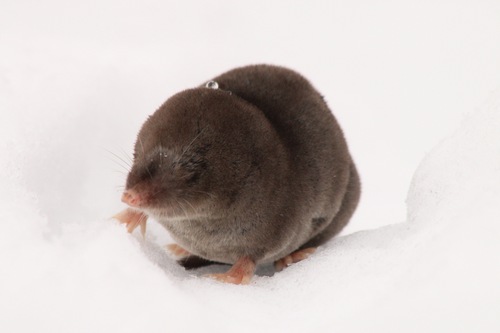
Northern Short-tailed Shrew
Blarina brevicauda
A pint-sized predator with a venomous bite and a secret talent for echolocation. The Northern Short-tailed Shrew is the hidden guardian of your garden's soil.
Quick Identification
Size
Total length of 10-14 cm (4-5.5 inches); Weight of 15-30 g (0.5-1.1 oz)
Colors
Uniform slate-gray or lead-colored fur with a velvety texture; slightly paler underbelly; dark, nearly black tail
Key Features
- Extremely short tail, less than 30% of body length
- Pointed, highly mobile snout
- Eyes so small they are barely visible
- Velvety fur that can be brushed in any direction
When You’ll See Them
Behavior
The Northern Short-tailed Shrew is a tiny bundle of relentless energy. Because of its exceptionally high metabolic rate, it must consume nearly its own body weight in food every day, leading to a lifestyle of near-constant foraging. Unlike many other small mammals, this shrew is venomous; its saliva contains a paralytic toxin that allows it to subdue prey much larger than itself, such as frogs or even small mice, though it primarily focuses on invertebrates.
These creatures are masters of the "sub-surface" world, spending much of their time in tunnels or under leaf litter. They are one of the few mammals known to use echolocation, emitting ultrasonic clicks to navigate through dark burrows and dense vegetation. While they are solitary and territorial, they rarely interact with humans directly, though they are excellent neighbors to have if you want to keep garden pests like grubs and snails under control.
EverydayEarth exclusive
Camera Tips
Capturing the Northern Short-tailed Shrew on camera requires a specialized approach because they are small, incredibly fast, and rarely venture into open spaces. To increase your chances, place your camera at ground level—literally sitting on the dirt or leaf litter. Aim the lens toward a known travel corridor, such as the edge of a log pile, a gap under a garden shed, or a visible tunnel entrance in the mulch. Because they are so small, your camera needs a very close focal point; if your device allows for macro adjustments or has a close-up lens attachment, use it.
Since these shrews rely heavily on their sense of smell, scent lures are highly effective. A small amount of pungent wet cat food or a few dried mealworms placed in front of the camera can pause their frenetic movement long enough for a clear shot. Be sure to clear away any tall blades of grass directly in front of the sensor, as these will trigger the camera in the wind and hide the tiny shrew from view. If your camera has a 'high' sensitivity setting for the PIR sensor, enable it to ensure the shrew's small heat signature triggers the recording.
Video mode is significantly better than photo mode for this species. Their movements are jerky and lightning-fast, often appearing as a gray blur in still images. A 10-15 second video clip will allow you to see their characteristic nose-twitching and rapid scurrying behavior. During the winter, look for them near bird feeders where they hunt for insects attracted to fallen seed, or place cameras near the foundations of your home where the soil stays slightly warmer.
Similar Species
Species that look similar or are commonly confused with Northern Short-tailed Shrew.
Frequently Asked Questions
Record Northern Short-tailed Shrew at your habitat
Connect a camera to start building your own species record — AI identifies every visitor automatically.