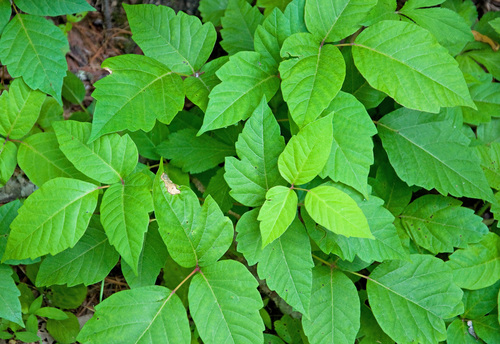
eastern poison ivy
Toxicodendron radicans
Don't let the 'leaves of three' scare you away. Eastern Poison Ivy is a stunningly colorful native plant that serves as a vital winter food source for dozens of backyard bird species.
Quick Identification
Size
Vines can reach 23 meters (75 feet) in length; shrubs grow 0.6 to 1.2 meters (2 to 4 feet) tall.
Colors
Glossy green leaves in spring and summer; vibrant yellow, orange, and red foliage in autumn; small off-white berries in winter.
Key Features
- Trifoliate leaves (sets of three)
- No thorns along the stem
- Hairy-looking aerial roots on climbing vines
- White or grayish waxy berries
- Alternate leaf arrangement
When You’ll See Them
Geographic range
Where Does the eastern poison ivy Live?
Eastern Poison Ivy is a quintessential North American native, stretching across the eastern half of the continent from the Atlantic coast to the Great Plains. It is found abundantly throughout the Eastern United States and Southern Canada, extending its reach southward into parts of Mexico and even Northern Guatemala. Because it thrives in disturbed soils and along the boundaries of developed land, it has become a permanent resident in suburban landscapes and urban green spaces wherever moisture and light are sufficient.
Basemap © OpenStreetMap contributors
Behavior
Eastern Poison Ivy is a resilient and adaptable perennial that plays a surprising role in local ecosystems. Unlike many plants that humans avoid, it provides significant value to wildlife. It spreads through both underground rhizomes and bird-dispersed seeds, often thriving in 'disturbed' areas where forests meet clearings. This allows it to colonize backyard edges and garden fences with ease, where it can grow as a ground cover, a free-standing shrub, or a thick climbing vine.
Its most famous trait is the production of urushiol, a potent oily resin found in all parts of the plant, including the roots and stems even in winter. This oil is a defense mechanism, though many animals—including white-tailed deer and over 60 species of birds—have evolved to consume the leaves or berries without ill effects. For humans, contact with even a trace amount of urushiol can cause an allergic reaction, making it a plant best observed from a distance or through a camera lens.
EverydayEarth exclusive
Camera Tips
Photographing Eastern Poison Ivy is an excellent way to document the changing seasons without the risk of physical contact. To capture its full life cycle, place your AI-powered camera on a sturdy stake or a nearby non-toxic tree about 3 to 5 feet off the ground, angled slightly downward to catch the distinctive 'leaves of three' structure. Because this plant is a biodiversity hub, positioning a camera near a berry-laden vine in the late fall or winter is a secret trick for capturing beautiful shots of Cedar Waxwings, Northern Cardinals, and Downy Woodpeckers that visit for a high-energy meal.
For those interested in the visual drama of nature, focus your camera on a specific cluster of leaves from late September through November. The transition from deep, glossy green to brilliant crimson and gold is one of the most striking visual transformations you can record in a backyard setting. Set your camera to a high-resolution photo mode with a trigger interval of 30 minutes if you want to create a time-lapse of the color change, or use standard motion-sensing to catch the various mammals and birds that use the thick vines for cover and nesting sites.
When setting up your equipment, remember the golden rule: never touch the plant. Use long-handled tools or wear heavy-duty disposable gloves if you must clear any obstructing grass near the camera base, and be mindful that urushiol oil can easily transfer from the plant to your camera housing or your hands. If your camera is placed in a dense patch, consider using a protective skin or a clear plastic wrap that can be carefully removed and disposed of later. To get the best identification results from your AI, ensure the camera is close enough to resolve the leaf margins and the 'hairy' texture of the vine's climbing roots.
Similar Species
Species that look similar or are commonly confused with eastern poison ivy.
Virginia Creeper
While they share the same habitat, Virginia Creeper typically has five leaflets and produces blue-black berries instead of white.
Western Poison Ivy
This species usually grows as a low-standing shrub and does not have the climbing 'hairy' vines characteristic of the Eastern variety.
Frequently Asked Questions
Record eastern poison ivy at your habitat
Connect a camera to start building your own species record — AI identifies every visitor automatically.