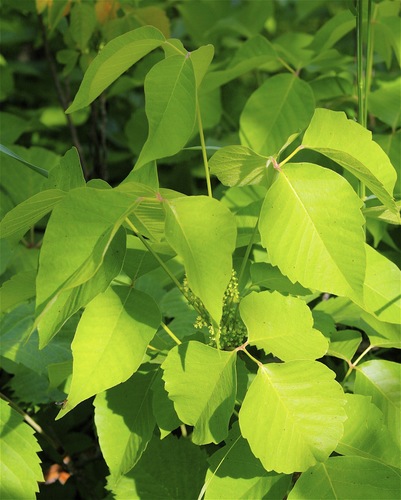
western poison ivy
Toxicodendron rydbergii
Western poison ivy is a hardy, sun-loving shrub known for its 'leaves of three' and brilliant autumn colors. While it demands respect and distance from humans, it serves as a vital sanctuary and food source for backyard birds and mammals.
Quick Identification
Size
Typically 30-100 cm (1-3.3 ft) tall; grows as a low, upright shrub rather than a climbing vine.
Colors
Glossy green leaves in spring/summer; vibrant yellow, orange, or red foliage in autumn; cream-colored or waxy white berries.
Key Features
- Compound leaves with three leaflets ('leaves of three')
- Lacks aerial climbing roots, grows as an upright shrub
- Middle leaflet has a longer petiolule (stalk) than side leaflets
- Small clusters of white or cream-colored berries
- Leaf edges are often coarsely toothed or notched
When You’ll See Them
Geographic range
Where Does the western poison ivy Live?
Western poison ivy is native to the North American continent, boasting a massive range that spans from the Atlantic coast of Canada across the Great Plains to the Pacific Northwest. It is the dominant species of poison ivy in the Rocky Mountains and the northern United States, thriving in higher altitudes and colder latitudes where the climbing eastern variety cannot survive. It is widely distributed across almost every province in Canada and the majority of the contiguous United States, excluding the deep Southeast.
Basemap © OpenStreetMap contributors
Behavior
In the spring and summer, the plant focuses on growth and flowering, producing small, inconspicuous yellow-green blossoms that develop into hard berries. These berries remain on the plant through the winter, providing a high-fat food source for birds when other food is scarce. To the plant, urushiol acts as a defense mechanism against herbivores, though many wild animals have evolved to eat the leaves and fruit without any reaction.
For homeowners and hikers, the behavior of this plant is marked by its seasonal change. It is one of the first plants to turn color in the fall, often flashing brilliant red long before the trees change. Even in winter, when the leaves have fallen, the dormant gray-brown stems and white berries remain toxic to human touch, making year-round identification vital for backyard safety.
EverydayEarth exclusive
Camera Tips
When using an AI-powered camera to document Western poison ivy, focus on the leaf structure. Position your camera on a short stake roughly 12 to 18 inches off the ground. This low angle is perfect for capturing the 'leaves of three' and the distinctively longer stalk of the central leaflet. Because this plant is stationary, it is an ideal subject for time-lapse photography, allowing you to observe the rapid transition from green summer leaves to the spectacular reds and oranges of autumn.
Western poison ivy is a 'wildlife magnet' for certain species. If you have a patch on the edge of your property, aim your camera there to see who visits. Northern flickers, pheasants, and various wood-warblers are frequently caught on camera eating the berries in late fall. Deer may also be seen browsing on the foliage. To get the best results, ensure the camera is placed in an area that receives dappled sunlight; direct, harsh midday sun can reflect off the glossy leaves and cause overexposure in your photos.
Safety is the most important factor when setting up cameras near this species. Always wear long sleeves and waterproof gloves when handling gear near Western poison ivy, as the urushiol oil can easily transfer from the plant to your camera housing and then to your skin later. If you are placing a camera to monitor a patch, try to do so during the dormant season (late winter) when the leaves are gone, though remember that the stems and berries are still toxic.
To help the AI identify the species accurately, try to capture the berries. The small, waxy, off-white clusters are a primary diagnostic feature that separates Western poison ivy from harmless lookalikes like Box Elder or Fragrant Sumac. Use a high-resolution setting and a fast trigger speed if you are hoping to catch the quick movements of birds landing in the ivy thicket to feed.
Similar Species
Species that look similar or are commonly confused with western poison ivy.
Eastern Poison Ivy
Eastern poison ivy is primarily a climbing vine with hairy-looking aerial roots, whereas Western poison ivy is a low-growing upright shrub.
Box Elder
Box Elder seedlings have three leaflets but their leaves grow opposite each other on the branch, while poison ivy leaves are alternate.
Fragrant Sumac
Fragrant Sumac has fuzzy red berries and the middle leaflet is attached directly to the stem without a long stalk.
Frequently Asked Questions
Record western poison ivy at your habitat
Connect a camera to start building your own species record — AI identifies every visitor automatically.