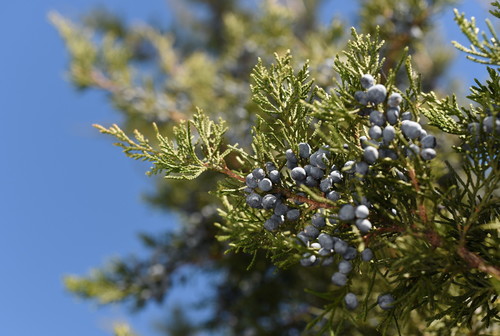
eastern redcedar
Juniperus virginiana
A hardy and aromatic pillar of the North American landscape, the eastern redcedar provides essential winter berries and dense shelter for dozens of bird species.
Quick Identification
Size
Typically 10-15 meters (30-50 feet) tall with a trunk diameter of 30-90 cm (1-3 feet); can occasionally reach 27 meters (90 feet).
Colors
Dark green to bluish-green foliage; reddish-brown fibrous bark; female trees produce dusty blue, waxy seed cones.
Key Features
- Scale-like mature leaves and prickly needle-like juvenile leaves
- Reddish-brown bark that shreds in long, thin strips
- Aromatic, rot-resistant heartwood with a distinct 'cedar' scent
- Small, berry-like blue cones on female specimens
When You’ll See Them
Geographic range
Where Does the eastern redcedar Live?
The eastern redcedar is a quintessential North American evergreen, native to a broad swath of the continent from the southeastern provinces of Canada down to the Gulf of Mexico. Its primary range covers almost the entire eastern half of the United States, extending from the Atlantic coast to the edge of the Great Plains. It is incredibly hardy, flourishing in the humid subtropical climates of the South as well as the frigid temperate zones of the North, making it one of the most widely distributed conifers in the East.
Basemap © OpenStreetMap contributors
Behavior
The eastern redcedar is a resilient pioneer species, often being the first tree to inhabit abandoned fields, eroded slopes, and roadside verges. It is a slow-growing but long-lived evergreen, with some specimens documented at over 900 years old. Its growth form is highly adaptable, appearing as a dense, pyramidal column in its youth and becoming more irregular and spreading as it reaches maturity.
Ecologically, this tree acts as a vital 'wildlife hotel.' Its dense, evergreen branches offer critical thermal cover for owls, cedar waxwings, and small mammals during harsh winter storms. While it is often managed in prairie environments to prevent encroachment, in a backyard setting, it serves as a cornerstone for biodiversity, providing both nesting sites and a high-energy winter food source through its berry-like cones.
EverydayEarth exclusive
Camera Tips
Setting up a camera near an eastern redcedar is a winning strategy for capturing a variety of bird species and small mammals. Because the tree provides dense cover, wildlife often use it as a 'staging area' before moving to feeders or open ground. Position your camera 5 to 10 feet away from the tree, aiming at the lower third of the foliage where birds like towhees and sparrows forage in the fallen needles, or mount it higher to capture cedar waxwings feeding on the blue cones.
In winter, these trees become magnets for life. If you have a female tree (identifiable by the blue berry-like cones), focus your camera on the fruit-laden branches. During snowstorms, this is often the only place to find activity as animals huddle for warmth. Use a faster shutter speed if your camera allows, as the fine needles and hopping birds move quickly, and ensure the PIR (motion) sensitivity is set to medium to avoid being triggered by wind-tossed branches.
Placement is key to avoiding 'white-out' photos at night. The bark of the redcedar is highly textured and can reflect infrared flash quite strongly. Angle your camera at a 45-degree angle to the trunk rather than head-on to minimize glare and show the depth of the foliage. If you are looking for predators like owls, look for 'whitewash' (droppings) on the ground under a redcedar and mount your camera on a nearby fence post or tree facing the interior branches where they often roost during the day.
Similar Species
Species that look similar or are commonly confused with eastern redcedar.
Frequently Asked Questions
Record eastern redcedar at your habitat
Connect a camera to start building your own species record — AI identifies every visitor automatically.