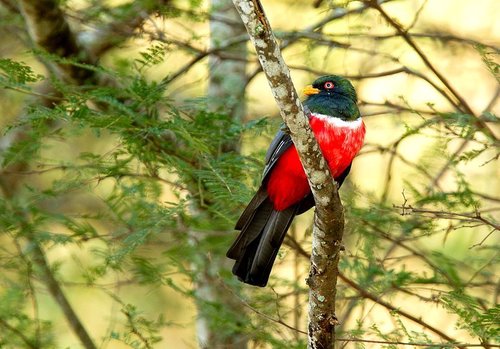
Ecuadorian Trogon
Trogon mesurus
A vibrant gem of the Tumbesian forests, the Ecuadorian Trogon dazzles with its golden belly and steady, stoic gaze. This resident of the western Andes is a master of the 'sit-and-wait' hunt, making it a rewarding challenge for wildlife photographers.
Quick Identification
Size
26–28 cm (10–11 inches) in length; weighs approximately 75–95 g (2.6–3.3 oz)
Colors
Males have a bright yellow belly, olive-green back, black throat, and a white breast band; females are primarily grayish-brown.
Key Features
- Vibrant yellow underparts with a clean white breast band
- Olive-green upperparts and a blackish face mask
- Pale yellow eye-ring and a heavy, pale bill
- Undertail is finely barred with gray and white vermiculations
When You’ll See Them
Geographic range
Where Does the Ecuadorian Trogon Live?
The Ecuadorian Trogon is native to South America, specifically the Pacific slope of the Andes. Its range is relatively restricted, found primarily in western Ecuador and extending south into northwestern Peru. It is a hallmark species of the Tumbesian region, where it occupies the transition zones between dry scrub and more humid tropical forests.
Basemap © OpenStreetMap contributors
Behavior
The Ecuadorian Trogon is a patient and relatively sedentary bird, often observed sitting motionless for long periods on mid-canopy branches. They exhibit a classic 'sallying' foraging behavior, where they remains still to scan for prey before making a sudden, fluttering flight to pluck an insect from a leaf or snatch a piece of fruit from a branch. Unlike more active forest birds, they are rarely seen hopping between branches, preferring to fly directly to a new perch.
Socially, they are usually found alone or in pairs. During the breeding season, they become much more vocal, emitting a distinctive series of low, rhythmic 'cow-cow-cow' notes that can carry quite a distance through the forest. While they are not overly shy around humans, their habit of sitting perfectly still makes them difficult to spot without a trained eye or the help of an AI-powered camera.
EverydayEarth exclusive
Camera Tips
To capture high-quality footage of an Ecuadorian Trogon, camera placement is everything. These birds are mid-story specialists, meaning they typically stay between 3 and 8 meters off the ground. For backyard or trail setups, position your camera at an upward angle or on a terrace that allows a clear view into the mid-canopy of native trees. Avoid placing cameras too low on the ground unless you are targeting a specific water source or low-hanging fruit.
The secret to attracting this species is food. Trogons are highly attracted to fruiting trees, particularly wild figs (Ficus) or native berries. If you have these in your yard, aim your camera at a sturdy, horizontal branch nearby; trogons prefer perching on stable limbs that offer a wide field of view for hunting. They are also known to nest in arboreal termite mounds, so if you spot a large, dark nest in a tree, placing a camera nearby during the breeding season (typically January through May) can provide spectacular results.
Because the Ecuadorian Trogon often sits perfectly still for minutes at a time, standard motion sensors might miss them. Set your camera to a high sensitivity and, if possible, use a 'time-lapse' mode that takes a photo every 5-10 minutes during peak morning hours. This ensures you catch them even when they aren't moving enough to trigger the PIR sensor. Use a fast shutter speed to compensate for their sudden, rapid flight bursts when they finally decide to move.
Similar Species
Species that look similar or are commonly confused with Ecuadorian Trogon.
Frequently Asked Questions
Record Ecuadorian Trogon at your habitat
Connect a camera to start building your own species record — AI identifies every visitor automatically.