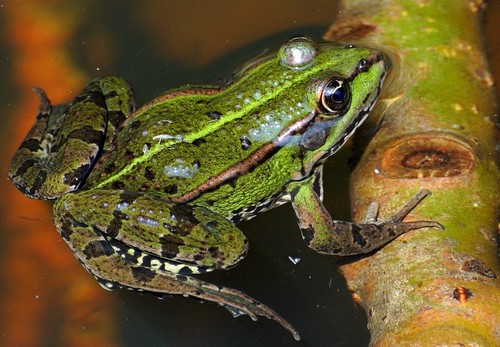
Edible Frog
Pelophylax esculentus
The Edible Frog is the vibrant, vocal star of the European pond. Known for its brilliant green hues and its habit of basking on lily pads, this resilient hybrid is a delight for backyard observers.
Quick Identification
Size
5-12 cm (2-4.7 inches) in length; 20-80 grams (0.7-2.8 oz)
Colors
Bright green to olive-brown skin with irregular dark spots; usually features a light green or yellow stripe down the center of the back; males have greyish-white vocal sacs.
Key Features
- Vivid green or brownish body with dark dorsal spots
- Light-colored stripe running down the center of the back
- Two prominent skin ridges (dorsolateral folds) along the sides
- Large, gold-rimmed eyes positioned high on the head
- Extensively webbed hind feet for swimming
When You’ll See Them
Geographic range
Where Does the Edible Frog Live?
The Edible Frog is widely distributed across the European continent, stretching from northern France and the United Kingdom through Central Europe to the Volga River in Russia. It is a common sight in the wetlands of Germany, Poland, and Italy, where it thrives in both natural and man-made aquatic environments. Though its native status in some northern regions like the UK is debated due to various historical introductions, it has successfully established robust populations across much of the temperate European landscape.
Basemap © OpenStreetMap contributors
Behavior
The Edible Frog is a highly aquatic species that rarely ventures far from the water's edge. They are famous for their love of sunbathing, often found perched on floating vegetation or muddy banks during the heat of the day. When threatened, they perform a sudden, powerful leap into the water, often emitting a short 'squeak' as they dive to the safety of the bottom mud.
These frogs are remarkably social and loud, particularly during the breeding season when males gather in 'leks' to call for mates. Their vocalizations are a complex mix of croaking and clicking that can carry for hundreds of metres across open water. While they are opportunistic hunters that sit and wait for prey, they are also quite territorial and will defend their preferred basking spots from other frogs.
EverydayEarth exclusive
Camera Tips
To capture the best footage of an Edible Frog, placement is everything. Position your camera just a few inches above the water line, focused on a 'basking station' like a flat rock, a partially submerged log, or a cluster of lily pads. These frogs are creatures of habit and will return to the same sunny spot daily. Use a camera with a wide-angle lens or a short focal distance to capture the intricate details of their spotted skin and golden eyes.
Since these amphibians are extremely sensitive to sudden movements, avoid placing the camera in a way that creates a moving shadow over the water. A side-on angle is often better than a top-down view, as it captures the frog's profile and its reflection in the water. If your camera supports it, use a high-speed video setting; their strike at a passing insect is lightning fast and often looks like a green blur at standard frame rates.
During the peak breeding months of May and June, ensure your camera's microphone is active. The Edible Frog's call is its most distinctive feature, and recording the male inflating his dual vocal sacs provides incredible behavioral insight. For the best results, set your camera to trigger on both motion and sound, as the vibrations of a loud chorus can sometimes be more reliable than visual motion detection in a busy, reed-filled pond environment.
Similar Species
Species that look similar or are commonly confused with Edible Frog.
Frequently Asked Questions
Record Edible Frog at your habitat
Connect a camera to start building your own species record — AI identifies every visitor automatically.