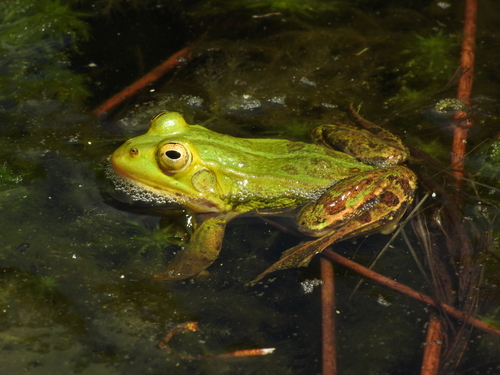
Pool Frog
Pelophylax lessonae
The vibrant green gem of European wetlands, the Pool Frog is a sun-loving acrobat famous for its rhythmic rattling call and impressive basking habits. Once thought lost to the UK, this resilient species is making a splashy comeback in backyard ponds and nature reserves alike.
Quick Identification
Size
Small to medium frog, typically 5–9 cm (2–3.5 inches) in length; weighing 20–50 grams (0.7–1.8 oz)
Colors
Usually bright grass-green or brownish-green with dark spots; often features a prominent yellow or pale green stripe down the center of the back (vertebral stripe); underbelly is creamy white without spots.
Key Features
- Distinct bright yellow or pale green line running down the spine
- Prominent dorsolateral folds (ridges) along the sides of the back
- Relatively short hind legs compared to other 'green frogs'
- Loud, vocal sacs in males that are white or pale grey when inflated
When You’ll See Them
Geographic range
Where Does the Pool Frog Live?
Native to the European continent, the Pool Frog's heartland stretches across Central and Eastern Europe, reaching from the eastern edge of France through Germany and Poland into Russia. While they are a staple of mainland European wetlands, they have a fascinating history in the United Kingdom, where the native 'northern clade' was once considered extinct before being successfully reintroduced to specific protected sites in East Anglia. Their range is largely defined by the presence of sun-exposed, still waters where they can bask and breed undisturbed, avoiding fast-moving rivers or deep, shaded lakes.
Basemap © OpenStreetMap contributors
Behavior
Pool Frogs are sun-loving amphibians that spend a significant portion of their day basking on the edges of ponds or on floating vegetation like lily pads. They are primarily diurnal, meaning they are most active during daylight hours, though they may continue their activities into warm evenings. Unlike many other frog species that prefer damp, shaded areas, the Pool Frog thrives in the heat, using the sun to regulate its body temperature and fuel its metabolism.
During the breeding season, which typically occurs from May to July, males become highly territorial and vocal. They form 'choruses' near the water's edge, using their twin vocal sacs to produce a rhythmic, rattling call to attract females. Despite being quite social during the mating season, they remain wary of predators; at the slightest sign of danger, they will leap into the water with a characteristic 'plop' and hide in the silt at the bottom.
Interaction with humans is generally passive. In garden settings, they can become quite bold if they feel safe, allowing observers to watch their hunting and basking behaviors from a distance. Because they hibernate on land rather than in the water, the presence of log piles or loose soil near a pond is essential for their year-round survival in a backyard environment.
EverydayEarth exclusive
Camera Tips
To capture the best footage of a Pool Frog, place your camera very low to the ground, ideally just a few inches above the water level at the edge of a pond. Focus your lens on a 'basking station'—this could be a flat rock, a half-submerged log, or a cluster of lily pads that receives direct sunlight for several hours a day. Because these frogs are small and cold-blooded, they may not always trigger traditional PIR (passive infrared) motion sensors. To combat this, use a camera with a high-sensitivity trigger or, better yet, set your device to time-lapse mode with intervals of 30 to 60 seconds during peak daylight hours.
If you are looking to record their famous vocalizations, placement is key during the late spring. Position the camera near the shallowest part of the pond where aquatic plants break the surface; this is where males tend to congregate to call. If your camera has a 'detect and record' video setting, ensure the microphone sensitivity is turned up, as the rattling call of the Pool Frog is distinctive but can be drowned out by wind or distant traffic.
For night-time captures, Pool Frogs are less active than at mid-day but may still be seen foraging on the bank. Use a camera with 'No-Glow' infrared LEDs to avoid startling them or washing out their reflective skin in the footage. Since they often return to the same basking spot day after day, once you identify a 'favorite' log, keep your camera there for at least a week to capture a full range of their behaviors, from hunting flies to interacting with other frogs.
Similar Species
Species that look similar or are commonly confused with Pool Frog.
Frequently Asked Questions
Record Pool Frog at your habitat
Connect a camera to start building your own species record — AI identifies every visitor automatically.