Ethiopian Wolf
Canis simensis
Meet Africa's most endangered carnivore, a specialized highland hunter found only in the peaks of Ethiopia. With its striking red coat and narrow snout, the Ethiopian Wolf is a rare gem of the Afroalpine wild.
Quick Identification
Size
Length: 84–101 cm (33–40 in); Weight: 11–19 kg (24–42 lbs); Height at shoulder: 53–62 cm (21–24 in)
Colors
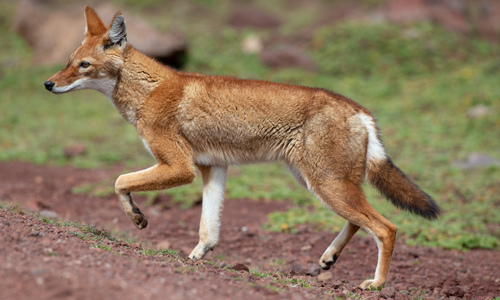
Cinnamon-red to tawny coat with white markings on the chin, throat, and chest; white underparts and inner limbs; bushy tail with a prominent black tip.
Key Features
- Slender, long-legged build resembling a coyote
- Long, narrow muzzle and pointed ears
- Distinctive reddish-orange fur with stark white underparts
- Bushy tail with a black tip and dark stripe along the top
When You’ll See Them
Geographic range
Where Does the Ethiopian Wolf Live?
The Ethiopian Wolf is native exclusively to the continent of Africa, where it is restricted to the high-altitude plateaus of the Ethiopian Highlands. This rare canid is found in just a handful of isolated mountain ranges, with the largest remaining populations residing in the Bale Mountains National Park and the Simien Mountains. They do not exist in any other country or region, making their survival entirely dependent on the preservation of these specific Ethiopian alpine ecosystems.
Basemap © OpenStreetMap contributors
Behavior
The Ethiopian Wolf is a fascinating study in social contradictions. While they live in tightly-knit social packs of up to 13 individuals—sharing territories and engaging in communal pup-rearing—they are solitary hunters. Unlike gray wolves that hunt in packs to take down large prey, the Ethiopian Wolf spends its day patrolling the afroalpine meadows alone, listening for the rustle of rodents beneath the grass. This unique social structure helps them defend prime rodent-rich territories against rival packs.
These canids are primarily diurnal, meaning they are most active during the daylight hours, which aligns with the activity patterns of their favorite prey. They are generally not aggressive toward humans, but they are highly susceptible to diseases carried by domestic dogs, such as rabies and distemper. Their interactions with other highland species, like the Gelada monkey, are often peaceful, with the wolves even using grazing monkey herds as camouflage to sneak up on unsuspecting rodents.
EverydayEarth exclusive
Camera Tips
To capture Africa's rarest carnivore, positioning your camera near active rodent colonies is the single most effective strategy. Because these wolves are highly specialized rodent hunters, they spend hours patrolling areas with high concentrations of Giant Mole-rats or grass rats. Look for 'hot spots' of rodent tunnels and place your camera on a low tripod or rock, roughly 18-24 inches off the ground, to capture the wolf's profile as it stalks through the grass.
Because the Ethiopian Wolf is diurnal, you should prioritize cameras with high-quality daytime sensors and fast trigger speeds. Their movement is often quick and jerky when pouncing, so a shutter speed that can handle motion without blurring is essential. Avoid using heavy scents or meat-based lures; these wolves are extremely specialized and are more likely to be attracted to the natural sounds and smells of their rodent prey than a foreign bait.
Placement on ridgelines and established animal trails is also highly effective. Packs use these routes to patrol the boundaries of their territory. Since the highland sun can be intense and cause overexposed images, try to angle your camera lens slightly downward or toward the north/south to avoid direct glare. If you are setting up during the breeding season (October to December), look for rocky outcrops or crevices that might serve as denning sites, but maintain a respectful distance to avoid disturbing the pack.
Similar Species
Species that look similar or are commonly confused with Ethiopian Wolf.
Black-backed Jackal
Smaller with a distinct silver-black 'saddle' on its back, compared to the solid red coat of the wolf.
Golden Jackal
Stouter build with a shorter muzzle and lacks the stark white chest markings and long legs of the Ethiopian Wolf.
Coyote
While similar in size, coyotes are native to North America and have a much broader diet and gray/brown fur coloration.
Frequently Asked Questions
Record Ethiopian Wolf at your habitat
Connect a camera to start building your own species record — AI identifies every visitor automatically.