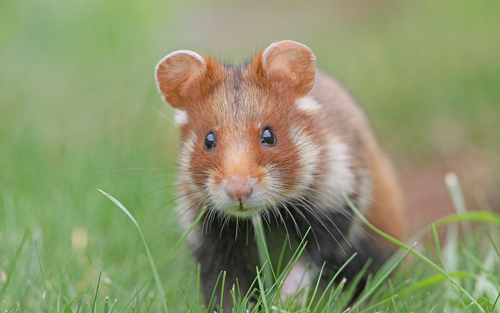
Eurasian Hamster
Cricetus cricetus
The Eurasian Hamster is a colorful, charismatic, and critically endangered architect of the grasslands. With its unique black belly and industrious nature, it is one of Europe's most striking but rarest backyard visitors.
Quick Identification
Size
20–35 cm (8–14 in) long with a short 3–6 cm tail; weight 220–460 g (8–16 oz)
Colors
Reddish-brown upperparts, white patches on the cheeks and sides, and a distinctive jet-black underbelly
Key Features
- Distinctive black fur on the belly and chest
- Large, expandable cheek pouches for carrying food
- Stocky build with short limbs and small, rounded ears
- Tri-colored coat with orange, white, and black markings
When You’ll See Them
Geographic range
Where Does the Eurasian Hamster Live?
The Eurasian Hamster is native to the temperate grasslands and fertile lowlands of the Palearctic region, stretching across a vast territory from Belgium and France in the west through Central and Eastern Europe to the Altai Mountains and Xinjiang, China. While its historic range was contiguous, modern populations are increasingly fragmented, with core strongholds now found in parts of Germany, Austria, and Poland. Interestingly, some of the most visible populations are now found in urban 'island' habitats within major European cities where traditional farming practices don't interfere with their burrows.
Basemap © OpenStreetMap contributors
Behavior
The Eurasian Hamster is a solitary and fiercely territorial architect of the underworld. Unlike their smaller pet relatives, these wild hamsters are surprisingly large and can be quite feisty if cornered. They spend the majority of their lives in complex burrow systems that can reach depths of over two meters, featuring separate chambers for nesting, food storage, and waste. They are crepuscular, meaning they are most active during the twilight hours of dawn and dusk when they emerge to forage for food to stock their winter larders.
Socially, they are reclusive and only seek out others during the breeding season. They are remarkable for their 'hoarding' behavior; a single hamster can collect up to 65 kilograms of food in its burrow to survive the winter. While they hibernate from October to March, they do not sleep continuously, instead waking every few days to eat from their stored supplies. In urban environments, they have shown surprising adaptability, often losing some of their fear of humans in exchange for the easy foraging found in city parks and gardens.
EverydayEarth exclusive
Camera Tips
To capture high-quality footage of the Eurasian Hamster, camera placement is the most critical factor. Because these animals are low-slung and ground-dwelling, you must position your camera just 10 to 15 centimeters (4-6 inches) off the ground. Aiming the lens toward the entrance of a burrow—identifiable by a hole roughly 6-10 cm wide with excavated soil nearby—is the most reliable way to ensure a sighting. If you are in a garden or park, place the camera along a wall, fence line, or hedge, as they prefer to travel along edges rather than crossing open ground.
Using a lure can significantly improve your chances of getting the hamster to pause in front of the lens. A small pile of sunflower seeds, crushed corn, or pieces of apple works wonders. Be sure to place the bait about a meter away from the camera to ensure the animal is within the focal range. Since they are most active during low-light hours, a camera with a high-quality 'no-glow' infrared flash is essential to avoid startling the animal and to prevent overexposed 'white-out' images at close range.
Seasonality is also key for your camera schedule. Do not expect any activity between October and late March, as they will be deep underground in hibernation. The best time for recording is during the breeding season in May and June, or in late August when they are frantically gathering food for the winter. During these peak times, use a 'burst' mode or short video clips (10-15 seconds), as these hamsters can move surprisingly quickly when they aren't distracted by food.
Similar Species
Species that look similar or are commonly confused with Eurasian Hamster.
Frequently Asked Questions
Record Eurasian Hamster at your habitat
Connect a camera to start building your own species record — AI identifies every visitor automatically.