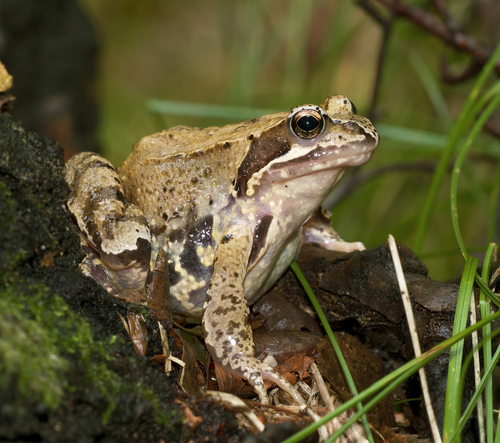
European Common Frog
Rana temporaria
The ultimate garden visitor, the European Common Frog is a master of disguise and a tireless gardener's ally, consuming pests under the cover of night.
Quick Identification
Size
Length: 6–9 cm (2.4–3.5 in); Weight: 20–40 g (0.7–1.4 oz)
Colors
Highly variable shades of olive-green, brown, or grey with dark blotches. Features a distinctive dark 'mask' behind the eye and a creamy, souvent speckled underside.
Key Features
- Dark brown patch or mask behind the eye
- Smooth, moist skin (not warty)
- Long hind legs designed for hopping
- Horizontal pupils in golden-brown eyes
When You’ll See Them
Geographic range
Where Does the European Common Frog Live?
The European Common Frog is native to the Palearctic realm, flourishing across almost the entirety of Europe and extending into parts of Asia. Its core range begins in the west with Ireland and the United Kingdom, stretching across mainland Europe to the Ural Mountains in Russia, and reaching as far north as the Arctic Circle in Scandinavia. While they are largely absent from the hotter, more arid regions of southern Italy and the Iberian Peninsula, their range continues eastward through Siberia to Japan, making them one of the most widely distributed amphibians in the world.
Basemap © OpenStreetMap contributors
Behavior
The European Common Frog is a resilient and adaptable amphibian that spends much of its adult life on land, returning to water primarily to breed or to escape extreme heat. During the day, they are masters of concealment, tucking themselves into cool, damp crevices under log piles, large stones, or within long grass to prevent their skin from drying out. They are most active during the night and in wet weather, when they emerge to hunt across garden lawns and forest floors.
In early spring, these frogs undergo a dramatic shift in behavior as they migrate back to their ancestral breeding ponds. This period is characterized by 'explosive breeding,' where hundreds of individuals congregate at once. Males produce a soft, low-pitched croaking sound—often described as a distant motorbike—to attract mates. Outside of the spring frenzy, they are largely solitary and can become quite familiar with a specific garden territory, often returning to the same overwintering spot year after year.
EverydayEarth exclusive
Camera Tips
To capture the European Common Frog on a backyard camera, you must think low. Since these amphibians stay close to the ground, your camera should be mounted no more than 10 to 15 centimeters (4-6 inches) high. Angle the lens slightly downward to focus on the edge of a garden pond, a damp rockery, or a 'frog highway'—the shadowed gaps between dense vegetation where they feel safe moving. Using a camera with a short focal distance or a wide-angle lens is best for capturing their detailed markings without blur.
Standard PIR motion sensors can sometimes struggle to detect the cold bodies of frogs. To improve your chances, place your camera near a 'rest stop' like a flat, mossy stone or a partially submerged log where frogs are likely to sit still for several minutes. If your camera has a time-lapse mode, setting it to take a photo every 30 seconds during a rainy night can often yield better results than relying purely on motion triggers. Ensure the sensitivity is set to 'High' to capture their relatively subtle movements.
Nighttime is the most productive period for filming. Use 'no-glow' or black-flash infrared LEDs to avoid startling the frogs or overexposing the image on their reflective, wet skin. During the spring breeding season (typically February to April), position your camera right at the water's edge to document the high-energy spawning activity. For the rest of the year, focus on damp, overgrown corners of the garden or near compost heaps where they congregate to hunt for slugs.
Similar Species
Species that look similar or are commonly confused with European Common Frog.
Frequently Asked Questions
Record European Common Frog at your habitat
Connect a camera to start building your own species record — AI identifies every visitor automatically.