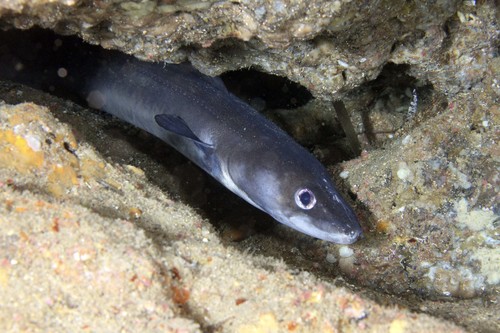
European Conger
Conger conger
The European Conger is the undisputed heavyweight of the eel world, a muscular nocturnal predator that haunts the shipwrecks and rocky reefs of the Northeast Atlantic. Growing up to three meters in length, these 'serpents of the sea' are as mysterious as they are massive.
Quick Identification
Size
Length up to 3 m (9.8 ft); weight up to 110 kg (242 lb)
Colors
Greyish to blackish-grey dorsal side with a paler, whitish or silvery underside; fins often edged with a distinct black border
Key Features
- Extremely long, scaleless cylindrical body
- Large head with a wide mouth and powerful jaws
- Dorsal fin begins directly above or just behind the pectoral fins
- Upper jaw is longer than the lower jaw
When You’ll See Them
Geographic range
Where Does the European Conger Live?
The European Conger is a master of the Northeast Atlantic's rocky depths, calling the waters from the coast of Norway and Iceland down to the North African shores of Senegal home. It is a staple of the Mediterranean and Black Seas, frequently found lurking in the crevices of coastal reefs and historic shipwrecks throughout the British Isles and Western Europe. While they are primarily seafloor dwellers in temperate zones, these impressive eels are known to migrate thousands of miles into the deep Atlantic to reach their spawning grounds.
Basemap © OpenStreetMap contributors
Behavior
The European Conger is a formidable, solitary predator that spends most of its daylight hours hidden within the safety of rocky crevices, underwater caves, or shipwrecks. As a nocturnal hunter, it emerges under the cover of darkness to prowl the seabed. Despite their fearsome reputation and impressive size, they are generally shy around humans unless provoked or cornered, though they are known to be extremely powerful and determined when hunting.
These eels have a fascinating life cycle characterized by a single, massive migration. After living for 5 to 15 years in coastal waters, adults undergo physiological changes and travel thousands of miles to deep-water spawning grounds in the Atlantic or Mediterranean. Once they spawn, having expended all their energy and ceased feeding, they die, leaving their transparent, leaf-like larvae (leptocephali) to drift back toward the coast on ocean currents.
EverydayEarth exclusive
Camera Tips
To capture the elusive European Conger, you will need a specialized underwater camera setup or a high-quality action camera in a waterproof housing rated for significant depth. Since these eels are strictly nocturnal, your camera must have infrared or red-light capabilities; bright white lights often startle them and cause them to retreat immediately into their holes. Position your camera on a weighted tripod or secure it directly to a rocky ledge or pier piling about 1 to 2 feet off the seabed, facing a known crevice or 'hole' where an eel might reside.
Baiting is the most effective way to draw a Conger into your camera's field of view. Use a mesh bait bag filled with highly aromatic, oily fish like mackerel, herring, or squid. Secure the bait bag firmly to a heavy object or the camera mount itself, as a large Conger possesses immense strength and can easily swim off with unsecured bait—potentially taking your camera with it. Set your camera to record in high-frame-rate video bursts, as their strikes are lightning-fast despite their bulky size.
Placement is key: for those with coastal 'backyards,' look for areas near private jetties, sea walls, or rocky shorelines during high tide. The best time to capture activity is during the two hours surrounding high tide at night, especially during the darker phases of the moon. Ensure your housing is cleaned of salt and algae regularly to maintain clarity, and always use a safety tether to prevent your gear from being dragged into a deep, inaccessible crevice by a curious giant.
Similar Species
Species that look similar or are commonly confused with European Conger.
Frequently Asked Questions
Record European Conger at your habitat
Connect a camera to start building your own species record — AI identifies every visitor automatically.