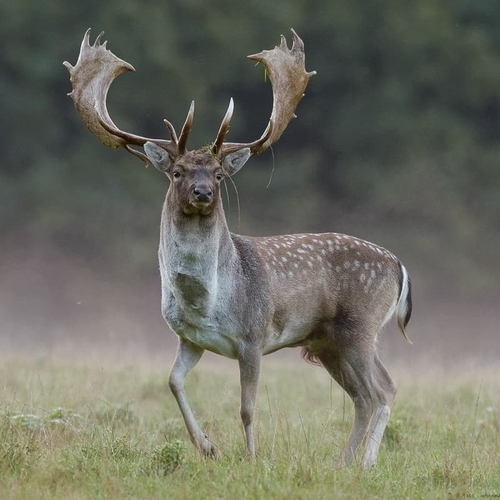
European Fallow Deer
Dama dama
With its iconic palmate antlers and elegant spotted coat, the European Fallow Deer is a majestic sight on any trail camera. Once a staple of royal deer parks, this resilient species now roams freely across woodlands and suburban estates worldwide.
Quick Identification
Size
Length: 140–160 cm (4.6–5.2 ft); Weight: 60–100 kg (130–220 lbs) for males, 30–50 kg (66–110 lbs) for females.
Colors
Varied coat colors including 'Common' (chestnut with white spots), 'Menil' (paler with spots), 'Melanistic' (black), and 'White'. Most feature a white rump patch with a black 'heart' outline and a black-striped tail.
Key Features
- Broad, shovel-like (palmate) antlers on mature males
- White spots that typically remain visible even in adulthood
- Distinctive long tail that wags while feeding
- Prominent Adam's apple in bucks during the rutting season
When You’ll See Them
Geographic range
Where Does the European Fallow Deer Live?
The European Fallow Deer is originally native to the Mediterranean region and Anatolia, but has become a global citizen over the last several centuries. They are now established across most of Europe, with particularly high densities in the United Kingdom, Germany, and Scandinavia. Beyond their native continent, successful populations have been introduced to North America, South Africa, Australia, and New Zealand, where they thrive in temperate climates.
Basemap © OpenStreetMap contributors
Behavior
European Fallow Deer are highly social mammals that typically live in sex-segregated herds for most of the year. Does and fawns form large groups, while bucks often live in smaller bachelor bands or as solitary individuals. During the autumn rut, their behavior shifts dramatically as bucks establish territories and vocalize with deep, guttural groans to attract mates. They are known for a unique gait called 'pronking' or 'stotting,' where they leap into the air with all four legs held stiffly when startled.
These deer are remarkably adaptable to human presence, often frequenting parklands and suburban fringes where they feel safe from predators. While they are primarily active at dawn and dusk, they may forage during the day in areas where they are unmolested. They are cautious and rely on their keen sense of smell and hearing to detect threats, often freezing in place before making a quick, bounding escape into thick cover.
EverydayEarth exclusive
Camera Tips
To capture high-quality footage of European Fallow Deer, mount your camera at a height of 3 to 4 feet (roughly chest height for an adult buck). This angle ensures you capture the full profile of the animal, including the impressive palmate antlers of the males. Look for natural funnels in your yard or local woodland, such as gaps in fences or clear paths through thickets. Because Fallow Deer are crepuscular, a camera with a fast trigger speed and high-quality infrared night vision is essential for clear images during the low-light hours of dawn and dusk.
During the autumn rut (October to November), move your cameras near 'rubbing trees' where bucks have scraped the bark off with their antlers. These areas become hubs of activity as males display their dominance. If legal in your area, a salt lick or mineral block can be an excellent way to pause the deer in front of your lens for several minutes, providing the AI with enough time to capture various angles of the animal’s markings. Be sure to face your camera north to avoid direct sunlight blowing out the image during their peak morning and evening activity.
Fallow deer are extremely sensitive to human scent and changes in their environment. When checking your camera, wear gloves to minimize scent transfer and try to blend the camera into the surroundings using camo tape or local foliage. These deer are known to be 'camera shy' if they notice a new object, so leave the camera in place for at least two weeks to allow the herd to become habituated to its presence. For the most interesting behavior, set your camera to 'Video Mode' to record their distinctive tail-wagging or social grooming.
Similar Species
Species that look similar or are commonly confused with European Fallow Deer.
Frequently Asked Questions
Record European Fallow Deer at your habitat
Connect a camera to start building your own species record — AI identifies every visitor automatically.