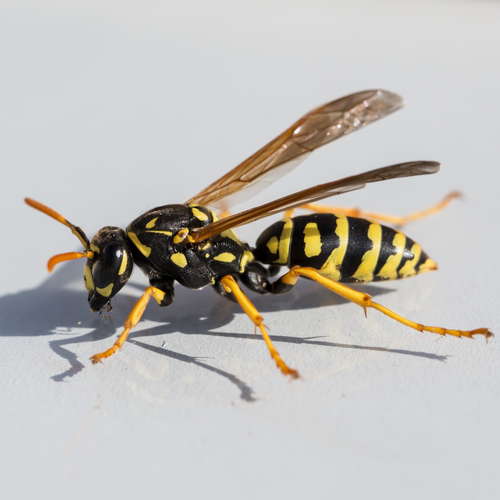
European Paper Wasp
Polistes dominula
The European Paper Wasp is a master of suburban survival, known for its open-faced nests and striking yellow and black patterns. A friend to gardeners, it acts as a natural pest control by hunting flies and caterpillars across our backyards.
Quick Identification
Size
Length 12-20 mm (0.5-0.8 inches); wingspan 25-30 mm (1-1.2 inches)
Colors
Vibrant yellow and black banding; antennae are primarily orange-tipped; males have curled antenna tips and yellow faces
Key Features
- Slender waist with spindle-shaped abdomen
- Long yellow legs that dangle visibly during flight
- Orange-tipped antennae (unlike most yellowjackets)
- Open, umbrella-shaped nest without an outer papery shell
When You’ll See Them
Geographic range
Where Does the European Paper Wasp Live?
Originally native to the Palearctic region spanning Europe, North Africa, and temperate Asia, the European Paper Wasp has become a highly successful invasive species. It is now established across much of North America, from southern Canada throughout the United States, as well as parts of South America and Australia. Its ability to thrive in human-altered landscapes has allowed it to outcompete many native paper wasp species in residential areas.
Basemap © OpenStreetMap contributors
Behavior
European Paper Wasps are highly social insects famous for their complex colony hierarchies and sophisticated nest architecture. Unlike many other wasp species, they often exhibit 'foundress associations,' where multiple queens may work together to start a single nest, though one dominant queen eventually takes control. They are remarkably intelligent for insects, with research suggesting they can recognize the unique facial patterns of other wasps in their colony.
In the backyard, these wasps are industrious foragers but generally non-aggressive toward humans unless their nest is physically disturbed. They spend their days patrolling garden plants for prey and scraping wood fibers from fences or decks, which they mix with saliva to create the grey paper for their nests. Because their nests are open-faced, you can often observe the various life stages—from eggs to larvae to pupae—tucked into the hexagonal cells.
EverydayEarth exclusive
Camera Tips
To get the best shots of European Paper Wasps, focus your camera on their favorite 'construction' sites. These wasps are frequently seen scraping wood fibers from unpainted cedar fences, wooden garden furniture, or old decks. Placing a camera 1-2 feet away from these weathered wood surfaces with a macro lens or close-focus setting will capture the fascinating behavior of the wasp 'chewing' the wood into paper pulp.
Water is a powerful attractant, especially during the peak of summer. Set up a shallow dish or a birdbath with floating corks or stones that provide a dry landing spot. Position your camera at a low angle relative to the water surface. AI-powered cameras with high frame rates are ideal here, as you can capture the moment they touch down and the distinctive way they dangle their long yellow legs during the approach and departure.
If you have identified a nest—often found under the eaves of a shed or inside a patio umbrella—mount your camera nearby during the evening when the wasps are dormant. By dawn, the camera will be ready to capture the morning 'warm-up' period where the colony is most active in tending to the larvae. Ensure the camera is angled to see into the open cells of the nest to observe the transition from egg to larvae. Avoid placing the camera directly against the nest to prevent defensive behavior.
Similar Species
Species that look similar or are commonly confused with European Paper Wasp.
Western Yellowjacket
Yellowjackets have black antennae and build enclosed nests often underground, whereas the European Paper Wasp has orange-tipped antennae and open nests.
Northern Paper Wasp
The Northern species is typically brownish-red with fewer yellow markings, while the European species is bright yellow and black, resembling a yellowjacket.
Frequently Asked Questions
Record European Paper Wasp at your habitat
Connect a camera to start building your own species record — AI identifies every visitor automatically.