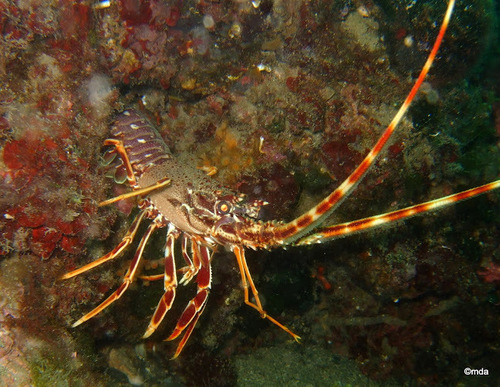
European Spiny Lobster
Palinurus elephas
Often called the 'crayfish' of the sea, the European Spiny Lobster is a vibrant, clawless crustacean that rules the rocky reefs of the Mediterranean and Atlantic with its whip-like antennae.
Quick Identification
Size
Total body length typically 25–40 cm (10–16 in), reaching a maximum of 60 cm (24 in); weighs up to 5 kg (11 lbs).
Colors
Reddish-brown to purple-brown shell with orange-yellow spines; abdomen features symmetrical white spots; legs are yellowish with darker brown stripes.
Key Features
- Heavy, spiny carapace lacking large front claws
- Two exceptionally long, thick, and spiny antennae
- Reddish-brown coloration with distinctive yellow spots on the tail
- Five pairs of walking legs with yellowish-orange hues
- Large, fan-shaped tail used for backwards propulsion
When You’ll See Them
Geographic range
Where Does the European Spiny Lobster Live?
Native to the Eastern Atlantic Ocean and the Mediterranean Sea, the European Spiny Lobster is a cornerstone of European marine ecosystems. Its core range extends from the chilly waters off the coast of Norway and the British Isles down to the warmer Mediterranean shores of Italy, Greece, and North Africa. While it is most concentrated in the rocky reefs of the Mediterranean, it maintains strongholds in the Atlantic along the coasts of France, Spain, and Portugal.
Basemap © OpenStreetMap contributors
Behavior
The European Spiny Lobster is a primarily nocturnal crustacean that spends its daylight hours tucked away in the safety of rocky crevices, underwater caves, or holes. Unlike the Common Lobster, it lacks large pincers; instead, it relies on its heavily armored, spiny shell and its long, whip-like antennae for defense. These antennae are sensitive to vibrations and chemical cues, allowing the lobster to detect predators or food from a distance.
Socially, they are known to be somewhat gregarious, often sharing crevices with other lobsters. During certain times of the year, they engage in seasonal migrations, moving to deeper waters in the winter to escape turbulent coastal storms and returning to shallower reefs in the spring for breeding. While generally shy, they can be surprisingly active at night, emerging from their dens to forage across the seafloor.
In interactions with humans, they are highly valued as a gourmet delicacy, which has led to significant fishing pressure. Because they grow slowly and take several years to reach maturity, they are sensitive to overfishing. For divers and underwater camera observers, they are fascinating subjects that often 'stridulate'—producing a loud rasping noise by rubbing their antennae bases against their heads to deter intruders.
EverydayEarth exclusive
Camera Tips
Capturing the European Spiny Lobster requires specialized underwater trail camera equipment or a waterproof housing rated for at least 30 meters. To attract them into the camera's field of view, use a perforated bait box or a mesh bag filled with oily fish (like mackerel) or crushed mussels. Secure the bait directly in front of the lens, ensuring it is anchored to the seabed so it doesn't drift away with the current.
Placement is critical for success. Look for 'lobster hotels'—deep, horizontal crevices in rocky reefs or the base of submerged cliffs. Position the camera at a slight upward angle near the entrance of these holes. Because they are nocturnal, you must use a camera equipped with high-quality infrared (IR) LEDs or a red-light filter. Standard white light can startle them and cause them to retreat back into their holes.
Set your camera to record video bursts of 20-30 seconds. This allows you to see the lobster’s fascinating behavior, such as using its antennae to investigate the bait or its rhythmic 'walking' motion. Be patient, as they may spend several minutes tentatively testing the area before fully emerging. In many regions, late spring and early summer are the best times to see them in shallower, reachable waters as they move up from the deep.
Similar Species
Species that look similar or are commonly confused with European Spiny Lobster.
Frequently Asked Questions
Record European Spiny Lobster at your habitat
Connect a camera to start building your own species record — AI identifies every visitor automatically.