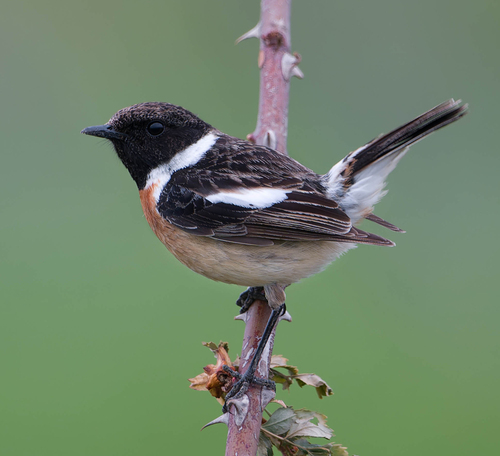
European Stonechat
Saxicola rubicola
With its vibrant orange breast and sharp 'clicking' call, the European Stonechat is a charismatic sentinel of the open heaths. This bold little flycatcher is a favorite for backyard cameras, often seen proudly surveying its kingdom from the very tip of a bush.
Quick Identification
Size
Length: 11.5–13 cm (4.5–5.1 in); Wingspan: 18–21 cm (7–8.3 in); Weight: 13–17 g (0.46–0.60 oz)
Colors
Males have a black head, white neck-sides, and a bright orange-red breast; females are browner with streaked backs and a paler orange wash on the breast.
Key Features
- Distinctive orange-red breast and black head (males)
- Upright perching posture on top of shrubs
- Constant flicking of wings and tail
- Call sounds like two stones being tapped together
When You’ll See Them
Geographic range
Where Does the European Stonechat Live?
The European Stonechat is native across a vast portion of the Western Palearctic, ranging from the rocky Atlantic coasts of Ireland and the United Kingdom across much of Central and Southern Europe. Its territory extends eastward through the Mediterranean and into Ukraine and the Caucasus region, with significant populations also residing in the coastal regions of Northwest Africa. While many Atlantic and Mediterranean populations are resident year-round, birds from the colder eastern and northern reaches of their range are partial migrants that move toward the Atlantic or Mediterranean basins during the winter months.
Basemap © OpenStreetMap contributors
Behavior
The European Stonechat is a restless and conspicuous bird, known for its habit of perching on the very highest twigs of bushes, gorse, or fence posts. From these vantage points, it surveys its territory for insects, frequently flicking its wings and tail in a characteristic nervous energy. Unlike many small birds that hide in thickets, the Stonechat prefers to be out in the open where it can see and be seen.
They are highly territorial birds and are often found in pairs year-round in milder climates. They are famous for their alarm call—a sharp, metallic 'tsak-tsak'—which sounds remarkably like two pebbles being struck together. This sound is often the first indication that a Stonechat is nearby, as they use it to warn intruders or signal to their mate.
EverydayEarth exclusive
Camera Tips
To successfully capture a European Stonechat on an AI-powered camera, you must think like a bird looking for a lookout tower. These birds are vertical specialists; they almost always choose the highest point in an open area to survey for prey. Instead of placing your camera at a bird feeder, mount it 3 to 5 feet off the ground and aim it directly at a prominent, isolated perch—such as the top of a fence post, a tall garden stake, or a protruding branch of a gorse bush. This 'sentinel' behavior makes them incredibly predictable subjects if you provide the right platform.
Because Stonechats are insect-eaters, traditional birdseed won't attract them. If you want to lure them into your camera's frame, consider placing a tray of live mealworms near the base of their favorite perch. They hunt by dropping down from a height to snag insects on the ground, so a camera angled slightly upward to catch the bird on its high perch, with the feeding tray just out of the bottom of the frame, can produce stunning 'hero' shots of the bird in its natural monitoring stance.
Timing and lighting are crucial for this species. They are most active during the early morning and late afternoon, often singing or calling most vigorously just after sunrise. Position your camera facing north or south to avoid the harsh backlighting of the rising or setting sun. In winter, Stonechats often move closer to human habitation and coastal gardens, so if you live in a temperate region, keep your camera active during the colder months when they might be bolder in their search for food near your home.
Similar Species
Species that look similar or are commonly confused with European Stonechat.
Whinchat
The Whinchat has a distinct broad white stripe above the eye and a more streaked, paler throat than the Stonechat.
European Robin
Robins have orange extending up onto the face around the eyes, whereas male Stonechats have a solid black head.
Siberian Stonechat
Extremely similar but usually has a larger white patch on the rump and paler underparts.
Frequently Asked Questions
Record European Stonechat at your habitat
Connect a camera to start building your own species record — AI identifies every visitor automatically.