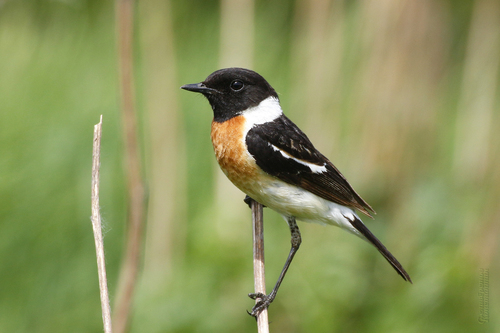
Siberian Stonechat
Saxicola maurus
A striking master of the open fields, the Siberian Stonechat is famous for its bold black-and-orange plumage and its habit of surveying the world from the highest perch it can find.
Quick Identification
Size
Length: 12.5–13 cm (4.9–5.1 in); Wingspan: 18–21 cm (7–8 in); Weight: 11–16 g (0.4–0.6 oz)
Colors
Male: Jet-black head, white half-collar, and deep orange breast with white rump. Female: Sandy-brown streaked back, pale buff throat, and muted orange wash on the breast.
Key Features
- Distinctive black head and white collar in breeding males
- Frequent, nervous wing and tail flicking while perched
- Upright, vertical posture on top of tall plants or posts
- Call sounds like two pebbles being struck together
- White wing patches prominent during flight
When You’ll See Them
Geographic range
Where Does the Siberian Stonechat Live?
This bird is a native of the vast East Palearctic, breeding across a massive range from Eastern Europe and Russia through Siberia to China and Japan. It is a dedicated long-distance traveler, migrating south to spend the winter months in the tropical warmth of Southern Asia and parts of Northeast Africa. In countries like India, Thailand, and Vietnam, it is a familiar winter sight in open fields and marshy edges.
Basemap © OpenStreetMap contributors
Behavior
The Siberian Stonechat is an energetic and highly visible songbird, often seen perched prominently on the tips of bushes, tall weeds, or fence posts. From these high vantage points, it scans the surrounding ground for movement. It employs a "sit-and-wait" hunting style, diving down to seize insects from the soil or low vegetation before returning to a perch—frequently the same one it just left. Its movements are characterized by a restless flicking of the wings and tail, which makes it easy to identify even from a distance.
These birds are strongly territorial during the breeding season and will actively chase off rivals or other small birds. While generally wary of human proximity, they are not shy about being seen and will often stay in one area for several days if the hunting is good. Their song is a brief, scratchy warble, but they are most vocal when sounding their alarm—a sharp, metallic clicking sound that gives the "stonechat" its name.
EverydayEarth exclusive
Camera Tips
To successfully capture a Siberian Stonechat on camera, you must take advantage of their perching habits. These birds almost always choose the highest available point in an open area to survey their territory. Identify a prominent vertical branch, a garden stake, or a fence post and aim your camera there. If your garden lacks a natural lookout, driving a 4-foot bamboo pole into the ground in an open area can act as an irresistible "stage" for the bird to land on.
Position your camera at a height of about 3 to 5 feet, roughly level with the top of their preferred perch. Because these birds are small, you will want the camera relatively close—about 6 to 10 feet away—to get high-quality AI identification and clear feather detail. Avoid placing the camera inside thick foliage, as Stonechats prefer unobstructed views where they feel safe from predators.
Since they are insect-eaters, standard birdseed won't attract them. Instead, focus on "luring" them with habitat. A small water feature or even a patch of turned-over soil can attract the insects they hunt. In the wintering grounds, they are most active during the golden hours of early morning and late afternoon. If using a motion-triggered camera, ensure the sensitivity is set high, as their quick wing-flicks and rapid pounces can sometimes happen too fast for slower sensors.
Similar Species
Species that look similar or are commonly confused with Siberian Stonechat.
Frequently Asked Questions
Record Siberian Stonechat at your habitat
Connect a camera to start building your own species record — AI identifies every visitor automatically.