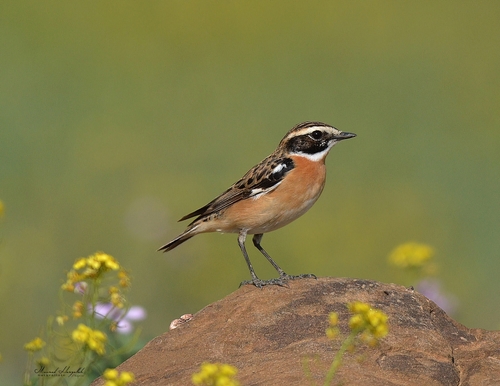
Whinchat
Saxicola rubetra
The Whinchat is a master of the open meadow, a striking migratory songbird known for its bold eye stripe and vibrant orange breast. Watch for this agile hunter as it surveys the grasslands from its favorite wildflower perch.
Quick Identification
Size
Length: 12-14 cm (4.7-5.5 in); Wingspan: 21-24 cm (8.3-9.5 in); Weight: 13-26 g (0.46-0.92 oz)
Colors
Mottled brown and black upperparts; prominent white or pale buff supercilium (eye stripe); male has a bright orange-buff throat and breast, whereas females are more muted with paler buff tones.
Key Features
- Bold white stripe above the eye
- Orange-buff breast and pale throat
- Short, dark tail with white patches at the base
- Frequent perching on tall weeds or fence posts
When You’ll See Them
Geographic range
Where Does the Whinchat Live?
Native to the Palearctic region, the Whinchat breeds across almost the entirety of Europe and Western Asia, reaching as far east as central Siberia. It is a true long-distance traveler, migrating south across the Mediterranean and Sahara to spend the northern winter in the tropical grasslands of sub-Saharan Africa. While its populations are widespread, it is increasingly restricted to areas where traditional low-intensity farming and rough grazing still exist.
Basemap © OpenStreetMap contributors
Behavior
The Whinchat is a classic 'perch-and-pounce' hunter. You will most often see them balanced atop a tall wildflower, a fence post, or a low shrub, surveying the surrounding grass for movement. When they spot prey, they dive down to the ground or occasionally snatch insects mid-air before returning to a prominent lookout. They have a characteristic habit of nervously flicking their wings and tail while perched.
Unlike many garden birds, Whinchats are highly migratory and do not stay in one place year-round. They are largely solitary during the breeding season, though they can be found in loose groups during migration and on their wintering grounds in Africa. They are generally shy around humans and prefer undisturbed open spaces, making them a special find for backyard observers with larger or more wild properties.
EverydayEarth exclusive
Camera Tips
To capture a Whinchat on camera, focus on their perching habits. Because they are ground-nesters but perch-hunters, you should place your camera about 2–3 feet off the ground, aimed at a prominent lookout point. A tall, sturdy weed like a dried mullein stalk, a wooden fence post, or a lone hawthorn bush in an open field is an ideal target. Angle the camera slightly upward to capture the bird's profile against the sky or a distant background for a professional look.
Since Whinchats are insectivores, traditional birdseed won't attract them. Instead, focus on creating a 'natural' lure by placing a tray of mealworms near a favorite perch, or better yet, maintain a patch of long, unmown grass which naturally draws in the beetles and flies they crave. High-speed shutter settings are essential, as these birds move quickly when diving for prey, and a trigger speed of 0.2 seconds or less will help ensure you don't just get a shot of a disappearing tail.
The best time to set your cameras is during the peak breeding season in May and June when males are most active and territorial. If your property borders a meadow or moorland, place cameras along the boundary. Because they are migratory, early morning light provides the best illumination for their orange breasts, especially during the 'golden hour' just after sunrise when they are most active in defending their territory and foraging.
Similar Species
Species that look similar or are commonly confused with Whinchat.
Frequently Asked Questions
Record Whinchat at your habitat
Connect a camera to start building your own species record — AI identifies every visitor automatically.