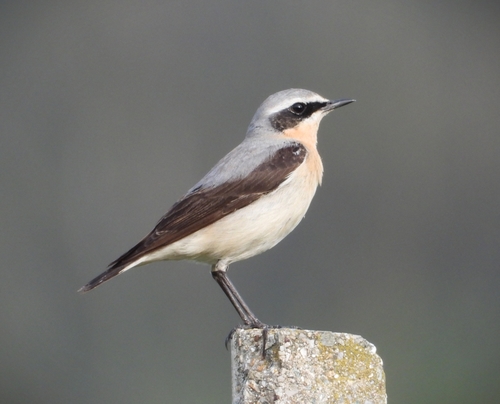
Northern Wheatear
Oenanthe oenanthe
A champion of long-distance travel, the Northern Wheatear is a hardy ground-dweller known for its striking white rump and incredible 18,000-mile migration journey.
Quick Identification
Size
Length 14.5–16 cm (5.7–6.3 in); wingspan 26–32 cm (10–12.5 in); weight 17–30 g (0.6–1.1 oz)
Colors
Breeding males have a blue-grey back, buff throat, and black eye mask. Females are sandy-brown. Both feature a brilliant white rump and a black T-pattern on the tail.
Key Features
- Distinctive white rump visible in flight
- Black T-shaped pattern on the end of a white tail
- Upright, 'standing' posture on rocks or mounds
- Frequent bobbing and tail-flicking behavior
When You’ll See Them
Geographic range
Where Does the Northern Wheatear Live?
The Northern Wheatear boasts one of the most extensive ranges of any songbird, originating across Europe and Northern Asia. It has successfully established breeding footholds in the Western Hemisphere, specifically in Alaska, the Yukon, and Northeastern Canada (including Greenland). Despite nesting across these vast northern stretches, the entire global population migrates to the tropical grasslands of Sub-Saharan Africa for the winter, making them a seasonal highlight for birdwatchers across multiple continents.
Basemap © OpenStreetMap contributors
Behavior
The Northern Wheatear is a restless, energetic songbird known for its terrestrial lifestyle. Unlike many flycatchers that wait on high branches, the wheatear is a ground-dweller that hops and runs across open, stony terrain with great agility. It is famously recognized for its 'bob-and-bow' movement, a rhythmic dipping of the body accompanied by a sharp flick of the wings and tail, which serves to flash its bright white rump.
This species is one of the most remarkable migrants in the avian world. Birds breeding in the Arctic regions of Canada and Alaska perform a staggering trans-oceanic flight to winter in Sub-Saharan Africa, covering up to 18,000 miles annually. They are generally solitary outside of the breeding season and can be quite territorial, often choosing a prominent rock or fence post as a lookout to survey for both predators and potential insect prey.
EverydayEarth exclusive
Camera Tips
To successfully capture a Northern Wheatear on camera, your setup needs to be low to the ground. These birds rarely perch in trees, preferring open, flat areas with plenty of visibility. Place your camera on a small tripod or mount it just 6 to 12 inches above the ground, aimed at a prominent 'sentry rock' or a low stone wall. Wheatears are creatures of habit and will repeatedly return to the same elevated stone to scan their surroundings.
Since they are insect hunters, traditional birdseed won't attract them. If you are in a migratory path, placing a small, shallow dish of mealworms near a flat rock can encourage them to stay within the camera's focal zone. Position your equipment in open areas of the yard—away from tall grass or thick shrubs—as they prefer a clear 360-degree view to feel safe from predators.
Settings are crucial for this species because of their constant movement. Use a fast shutter speed or a high-frame-rate video setting to catch their signature tail-flicks and bobbing. Migration periods in early spring and late summer are your best windows for detection. If your camera has a 'time-lapse' or 'burst' mode, use it to ensure you catch the moment they land on their preferred perch, as they often stay for only a few seconds before darting off after an insect.
Similar Species
Species that look similar or are commonly confused with Northern Wheatear.
Frequently Asked Questions
Record Northern Wheatear at your habitat
Connect a camera to start building your own species record — AI identifies every visitor automatically.