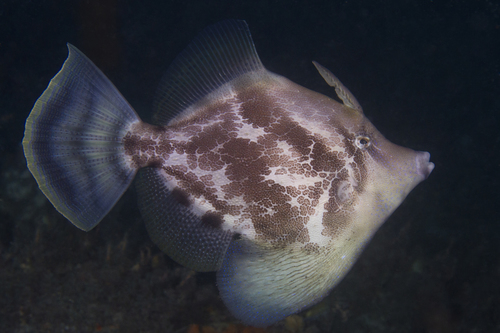
Fanbelly Leatherjacket
Monacanthus chinensis
A master of disguise with a secret architectural flair, the Fanbelly Leatherjacket is the quirky diamond of the Indo-Pacific shallows. Known for its sandpaper skin and a spectacular retractable fan, this reef-dweller is a favorite for underwater observers.
Quick Identification
Size
Typically 20–30 cm (8–12 in), reaching a maximum total length of 40 cm (16 in).
Colors
Mottled olive-green, brown, or tan with darker blotches and spots. Males are more colorful with a prominent, often yellowish or orange-tinged ventral fan.
Key Features
- Large, expandable fan-like belly flap (ventral flap)
- Retractable first dorsal spine with smaller barbs
- Rough, sandpaper-like skin texture
- Deep, diamond-shaped body profile
When You’ll See Them
Geographic range
Where Does the Fanbelly Leatherjacket Live?
Native to the Indo-West Pacific, the Fanbelly Leatherjacket is a common sight along the tropical and subtropical coastlines of Asia and Australia. Its core range extends from southern Japan and the South China Sea through the Philippines and Indonesia, reaching as far south as the northern and eastern coasts of Australia. These fish are most frequently encountered in the nutrient-rich, shallow waters of the Coral Triangle and along protected continental shelves.
Basemap © OpenStreetMap contributors
Behavior
The Fanbelly Leatherjacket is a relatively slow-moving fish that relies on its mottled patterns to blend into seagrass and reef environments. It moves primarily through the undulating motions of its second dorsal and anal fins, allowing it to hover precisely while searching for food. When threatened, it uses its rigid first dorsal spine to lock itself into rocky crevices or to appear larger to potential predators.
These fish are generally solitary but can be found in pairs during the breeding season. They are remarkably curious and will often approach underwater cameras or divers to investigate new objects in their territory. While they are not schooling fish, high-density areas of seagrass may support several individuals in close proximity, each maintaining a loose territory centered around a preferred hiding spot.
EverydayEarth exclusive
Camera Tips
To capture high-quality footage of a Fanbelly Leatherjacket, you should focus your efforts on shallow, sheltered waters. The best results are often achieved by mounting an underwater camera to a pier pylon or a weighted tripod placed near the edge of a seagrass bed. Because these fish are often found in silty environments, timing your recording with the incoming high tide will ensure the clearest water and best visibility.
Since leatherjackets are naturally curious, they are easily attracted to bait. A small mesh 'chum bag' filled with crushed mollusks or fish scraps tied approximately 30-50 cm (12-20 in) in front of the lens will almost certainly draw them in. Be sure to secure the bait bag firmly, as they have strong teeth and will attempt to tear into the mesh. Use a wide-angle setting to capture the full body shape when they display their fan belly.
Lighting is crucial for revealing their intricate mottled patterns. Try to set up your camera in 1-3 meters of water during the middle of the day when the sun is directly overhead. If you are using a trail camera in an underwater housing, set it to record short video bursts (15-30 seconds) rather than still photos, as their unique swimming motion—gliding with tiny fin movements—is one of their most interesting characteristics to document.
Pay attention to the background of your shot. Positioning the camera so it looks slightly upward or across a patch of bright green seagrass will provide a beautiful color contrast against the fish's earthy tones. If you notice a leatherjacket 'wedging' itself near your camera, it likely feels threatened; give it space and it will eventually emerge and return to its characteristic inquisitive behavior.
Similar Species
Species that look similar or are commonly confused with Fanbelly Leatherjacket.
Frequently Asked Questions
Record Fanbelly Leatherjacket at your habitat
Connect a camera to start building your own species record — AI identifies every visitor automatically.