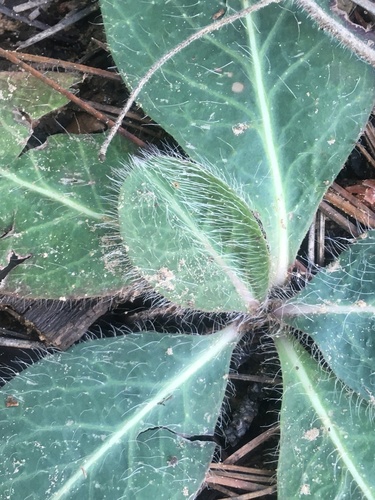
Fendler's Hawkweed
Hieracium fendleri
With its shaggy, silver-haired leaves and bright yellow blooms, Fendler’s Hawkweed is a resilient gem of the Western mountains. It serves as a vital oasis for high-altitude bees and butterflies across the North American cordillera.
Quick Identification
Size
Height of 15–45 cm (6–18 inches); basal leaves 5–15 cm (2–6 inches) in length
Colors
Pale yellow flower heads; light green to bluish-green leaves covered in long, shaggy white or yellowish hairs
Key Features
- Basal rosette of densely hairy leaves
- 1-5 pale yellow, dandelion-like flower heads
- Long, spreading white hairs (up to 5mm) on stems and leaves
- Leafless or nearly leafless flowering stalks
When You’ll See Them
Geographic range
Where Does the Fendler's Hawkweed Live?
Fendler's Hawkweed is a quintessential plant of the Western North American highlands, originating in the rugged mountain ranges of the continental interior. Its range extends from the northern reaches of the Black Hills in Wyoming and South Dakota, stretching southward through the Rocky Mountains and the Sky Islands of the Southwest. It continues its distribution through the cordilleras of Mexico, eventually reaching its southernmost limits in the high-elevation regions of Guatemala.
Basemap © OpenStreetMap contributors
Behavior
Unlike invasive hawkweed species that spread through aggressive runners, Fendler’s Hawkweed is a well-behaved native that grows in loose colonies. It interacts with the environment primarily through its relationship with native bees and small butterflies. After pollination, it produces small, ribbed fruits attached to a feathery 'pappus,' which allows the seeds to be carried away by the wind, much like a dandelion.
In a backyard or trail setting, this plant is a 'silent' resident. It doesn't move or make noise, but its growth cycle is a fascinating indicator of seasonal changes. It is particularly drought-tolerant once established, using its deep taproot and shaggy leaf hairs to reduce water loss in the arid western sun.
EverydayEarth exclusive
Camera Tips
Because this species is a favorite of native pollinators, set your camera's trigger sensitivity to high or use a time-lapse mode with intervals of 30 seconds. This is the best way to catch rapid-moving visitors like hoverflies, leafcutter bees, and small skippers that might not stay long enough to trigger a standard PIR sensor. If your camera allows for focal adjustment, set it to focus roughly 18 inches away to ensure the delicate textures of the petals are sharp.
Lighting is your biggest challenge and your best friend. The pale yellow flowers can easily 'blow out' and lose detail in the harsh midday sun of the Western mountains. For the most professional look, ensure your camera is positioned to catch the early morning or late afternoon 'golden hour' light. This low-angle sun will catch the shaggy white hairs on the leaves and stems, making the plant appear to glow against the darker forest floor or rocky background.
In windy conditions, which are common in its native habitat, use a faster shutter speed if your camera settings allow, or place a small, natural windbreak (like a nearby rock or log) just out of the frame to keep the flower heads from blurring. During the late summer, keep the camera in place to capture the transition from flower to seed head, as the white feathery plumes provide a beautiful geometric subject for high-contrast black and white photos.
Similar Species
Species that look similar or are commonly confused with Fendler's Hawkweed.
Frequently Asked Questions
Record Fendler's Hawkweed at your habitat
Connect a camera to start building your own species record — AI identifies every visitor automatically.